

October 7 Full Research Report
Engineered failure: Evidence of foreknowledge, enabling, and cover-up regarding the Hamas attacks of October 7, 2023
Overview
The October 7, 2023, Hamas attack on Israel, which claimed ~1,200 lives and resulted in 251 hostages taken by Hamas, has been widely characterized as an intelligence failure of historic proportions. However, a systematic examination of the available evidence reveals that elements within Israeli political and military leadership not only had substantial foreknowledge of the attack but deliberately enabled its success through a series of calculated actions and inactions.
Israeli intelligence possessed Hamas’s detailed attack plan, codenamed “Jericho Wall,” more than a year before the attack occurred. The 40-page document outlined the very assault that Hamas eventually carried out, including specific tactics for breaching border defenses, infiltrating communities, and taking hostages. Despite possessing this blueprint, Israeli authorities dismissed it as “aspirational” and beyond Hamas’s capabilities, even as Hamas conducted training exercises that mirrored these plans in plain sight of Israeli surveillance.
Beyond the battle plans, Israel received warnings from Egyptian intelligence services days before the attack. Prime Minister Benjamin Netanyahu initially denied that Israel received warnings entirely, but these were later confirmed by multiple sources. Female surveillance soldiers monitoring the Gaza border reported unusual Hamas activities for months – including drones, border excavations, and mock assault drills – warnings that were systematically “dismissed” by their commanders. Some intelligence professionals provided detailed reports warning explicitly of an imminent attack – an attack that perfectly aligned with the existing attack plans Israel already possessed. The night before the attack, Israeli intelligence identified at least five anomalous signs of highly unusual Hamas activity, but “failed” to interpret them as indicating an imminent threat.
In the period leading up to October 7, Israeli authorities systematically weakened defenses along the Gaza border by redeploying troops away from the area, degrading intelligence capabilities, and approving a large music festival near the border despite explicit security concerns. During the attack itself, communication systems failed, and military responses were inexplicably delayed, allowing Hamas to continue its assault for hours without any serious IDF opposition.
In the aftermath, Netanyahu attempted to deny that warnings existed and shifted blame onto security officials through social media posts he later deleted, while implementing censorship measures and resisting calls for an independent investigation. After more than 2 and a half years, we still lack a comprehensive investigation, while only limited and proscribed investigations exist. This pattern indicates information is being concealed.
The attack came as Netanyahu faced unprecedented domestic political protests regarding his judicial reforms, declining approval ratings, and ongoing corruption trials. This adds another disturbing dimension to these events. The attack immediately halted the protests, unified the political opposition behind the war effort, and advanced the ideological objectives of his far-right coalition partners. The attacks also enabled ideologues in Israel, who were firmly entrenched within the governing coalition, to pursue wider domestic and regional goals.
This report examines the extensive evidence of foreknowledge, the systematic weakening of defenses, the comprehensive failures during the attack, the subsequent efforts to suppress information, and multiple motives. It also explores Netanyahu’s long-standing policy of treating Hamas as a strategic asset that served his political objectives, including the direct approval of more than a billion dollars to Hamas,, despite warnings that this money was strengthening Hamas’s military capabilities.
Based on the evidence presented, we call for a transparent and comprehensive commission. However, a suitable investigation appears highly unlikely, even if a commission is established. Therefore, we also seek an open-source public investigation, assisted by whistleblowers from Israel and additional foreign nations. This is detailed further in the conclusion.
The victims of this tragedy deserve nothing less than the full truth about how and why this horrific tragedy occurred. In a wider lens, the entire world, and a growing number of victims of rolling Israeli acts of aggression, deserve the truth. Full and complete exposure of this issue may be the best way to seek de-escalation in the near term and allow the region to seek actual peace and coexistence in the longer term.
Navigator
Overview

1. Foreknowledge
1.1 Israel had the detailed Hamas attack plan… for over a year
1.2 Egyptian intelligence warnings and diplomatic communications
1.3 Hamas activities, preparations, and clear warnings from within
1.4 Human intelligence (HUMINT) and signals intelligence (SIGINT)?
1.5 Smoking gun testimony?
1.6 Stock shorting, Hamas videos detailing the attack, Israeli civilian foreknowledge, and other oddities

2. Engineered weakness?
2.1“Strategic” diversion from the Gaza front, and generally degraded status of forces
2.2 “Loss” of intelligence
2.3 Civilian protection failure: The Supernova Music Festival

3. The attack: Everything fails, or “fails”?
3.1 Communication breakdown
3.2 Delayed response: Hours to arrive – then a delay to engage?
3.3 Was there a “stand down”?
3.4 The Hannibal Directive and friendly fire: IDF killing their own

4. The cover-up begins
4.1 Delete that tweet
4.2 Censorship, self-censorship, and disappearing (or restricted) evidence?
4.3 No comprehensive investigation – 2 and a half years and counting
4.4 Feigned ignorance

5. Hamas – Strategic asset?
5.1 Hamas as a strategic asset – formaldehyde for Palestinian freedom
5.2 Suitcases of cash

6. Multitude of motives
6.1 Domestic concerns
6.2 Likud, Netanyahu, and the Revisionist Zionists: Demographic and territorial goals?

7. Conclusion

8. References
1. Foreknowledge
The October 7, 2023, Hamas attack on Israel represents one of the most significant intelligence failures in Israeli history. However, evidence indicates this was not merely a failure, but a deliberate engineering of circumstances that shaped the events of October 7. Multiple sources of specific foreknowledge existed within Israeli intelligence circles – including detailed battle plans, explicit warnings from foreign intelligence services, observable training, and unusual Hamas activities. It even included detailed intelligence reports explicitly warning of an imminent attack. This section examines the extensive evidence showing that elements within Israeli political and military leadership had substantial advance knowledge of Hamas’s intentions, capabilities, and training exercises – yet failed to take even basic countermeasures based on this information.
1.1 Israel had the detailed Hamas attack plan… for over a year
In what represents perhaps the most damning evidence of foreknowledge, Israeli intelligence obtained Hamas’s detailed attack plan, codenamed “Jericho Wall” (חומת יריחו), more than a year before the October 7 attack. According to an investigation by the New York Times, Israeli officials had acquired this 40-page document outlining Hamas’s battle plan as early as 2022.1 The Shin Bet, Israel’s domestic security agency, later confirmed they had obtained versions of Hamas’s battle plans in both 2018 and 2022, which Hamas had codenamed “The Promise of Judgment Day”.2
The “Jericho Wall” document contained a point-by-point outline of the exact type of assault that Hamas eventually carried out, including details about overwhelming Israeli border defenses, infiltrating Israeli communities, and taking hostages. The plan detailed tactics for breaching the border fence, neutralizing security cameras and automated machine guns, and conducting a coordinated land, sea, and air attack.3 In late 2023, The New York Times detailed the following:4
The approximately 40-page document, which the Israeli authorities code-named “Jericho Wall,” outlined, point by point, exactly the kind of devastating invasion that led to the deaths of about 1,200 people.
The translated document, which was reviewed by The New York Times, did not set a date for the attack, but described a methodical assault designed to overwhelm the fortifications around the Gaza Strip, take over Israeli cities and storm key military bases, including a division headquarters.
Hamas followed the blueprint with shocking precision. The document called for a barrage of rockets at the outset of the attack, drones to knock out the security cameras and automated machine guns along the border, and gunmen to pour into Israel en masse in paragliders, on motorcycles and on foot – all of which happened on Oct. 7.
The plan also included details about the location and size of Israeli military forces, communication hubs and other sensitive information, raising questions about how Hamas gathered its intelligence and whether there were leaks inside the Israeli security establishment.
Despite possessing this detailed battle plan, Israeli military intelligence officials dismissed it as “aspirational” and “beyond Hamas’s capabilities.”5 According to Combating Terrorism Center at West Point, this dismissal stemmed from “a fundamental misunderstanding of Hamas” and its intentions.6 The centrality – and unbelievability – of this general excuse is discussed in section 4.4, and in the conclusion.
In a CNN interview on December 1, 2023, Mark Regev – Senior Adviser to Prime Minister Netanyahu – was confronted with evidence about the Jericho Wall document. When asked about how the document matched the actual attack “point by point,” Regev admitted: “It was shockingly close to reality.”7 This admission from Netanyahu’s own senior adviser confirms that Israeli intelligence possessed detailed foreknowledge of the attack but somehow dismissed it.
Colonel Miri Eisen, a former senior Israeli intelligence officer, admitted it bluntly in a PBS interview: “The terror plans of Hamas were known and discounted. That’s the worst part.”8 The Shin Bet’s own investigation into the October 7 failure acknowledged that they had Hamas’s battle plans but “did not translate it into an actionable threat.”9
Perhaps most troublingly, when Hamas began conducting training exercises that precisely mirrored the “Jericho Wall” plan in the months and weeks leading up to October 7, these activities were observed by Israeli surveillance but universally dismissed by superiors as routine training rather than preparation for an actual attack.10 The overt Hamas activities mirroring the “Jericho Wall” document are discussed in sections 1.1 and 1.3. This pattern of dismissal cannot be accounted for by negligence or incompetence.
1.2 Egyptian intelligence warnings and diplomatic communications
Beyond possessing Hamas’s battle plans, Israel also received alarming warnings from Egyptian intelligence services in the days leading up to the attack. According to Michael McCaul, the chair of the US House Foreign Affairs Committee, Egypt warned Israel about a potential Hamas attack three days before October 7.11 Speaking after an intelligence briefing to senior members of Congress, McCaul stated:
We know that Egypt has warned the Israelis three days prior that an event like this could happen… I don’t want to get too much into classified [details], but a warning was given. I think the question was at what level.1213
His revelation directly contradicted Israeli Prime Minister Benjamin Netanyahu’s initial claims that Israel had received no advance warning. When reports first emerged about Egyptian warnings, Netanyahu dismissed them as “fake news” to Israelis.14 However, multiple sources have since confirmed that Egyptian intelligence officials had indeed passed on warnings about unusual Hamas activities and an impending attack, in stark terms.
According to The Guardian, Egyptian intelligence officials had detected unusual movements and communications among Hamas operatives in Gaza and conveyed this information through diplomatic channels to their Israeli counterparts.15 The warnings reportedly included specific concerns about “something big” being planned by Hamas.
Egyptian officials have expressed frustration that their dire warnings were not taken seriously. Egyptian intelligence had warned Israel about Hamas activities along the Gaza border and had urged immediate precautionary measures. The Times of Israel reported the following regarding warnings from Egypt:16
“We have warned them an explosion of the situation is coming, and very soon, and it would be big. But they underestimated such warnings,” the official, who spoke on condition of anonymity because he wasn’t authorized to discuss the content of sensitive intelligence discussions with the media, told The Associated Press.
Netanyahu denied receiving any such advance warning, saying in the course of an address to the nation Monday night that the story was “fake news.”
“No early message came from Egypt and the prime minister did not speak or meet with the intelligence chief since the establishment of the government – not indirectly or directly,” his office said in a statement earlier in the day.
In one of the said warnings, Egypt’s Intelligence Minister General Abbas Kamel personally called Netanyahu only 10 days before the massive attack that Gazans were likely to do “something unusual, a terrible operation,” according to the Ynet news site.
Unnamed Egyptian officials told the site they were shocked by Netanyahu’s indifference to the news and said the premier told the minister the military was “submerged” in troubles in the West Bank. [emphasis added]
The multiple reports of warnings from Egypt carried in major Western and Israeli news outlets have effectively confirmed that Netanyahu was lying in his initial blanket denials. Dire warnings were given.
1.3 Hamas activities, preparations, and clear warnings from within
In the months and weeks leading up to October 7, Israeli surveillance detected numerous unusual Hamas activities along the Gaza border that should have triggered heightened alert levels, if not direct military engagement. These activities, observed by both technological means and human observers, closely mirrored the tactics outlined in the “Jericho Wall” plan but were repeatedly dismissed by senior military leadership.
Female surveillance soldiers from the IDF’s lookout units, known as tatzpitaniyot (תצפיתניות), reported observing suspicious Hamas activities for months before the attack.17 These soldiers, who serve as the “eyes of the army” by monitoring security cameras and sensors along the border, documented Hamas fighters conducting training exercises that precisely matched the invasion plans Israel already possessed. Their observations included a stark shift to open tactical training, for exactly what occurred:18
“We would see them practising every day what the raid would look like,” Noa, who is still serving in the military, tells the BBC. “They even had a model tank that they were practising how to take over.”
“They also had a model of weapons on the fence and they would also show how they would blow it up, and co-ordinate how to take over the forces and kill and kidnap.”
Eden Hadar, another observer from the base, remembers that at the start of her service, Hamas fighters were doing mainly fitness training in the section she looked over. But in the months before she left the military in August, she noticed a shift to “actual military training”.
A comprehensive PBS Amanpour & Company investigation broadcast on October 9, 2024, documented how these female soldiers’ warnings were systematically ignored. The investigation revealed that “months before the attack they had reported suspicious activity… but their warnings were ignored.”19 The tragic consequence: 15 of these female observers were killed and 7 were kidnapped on October 7 – the very women whose warnings had been dismissed.
According to a report in Politico the tatzpitaniyot at a base in Nahal Oz reported Hamas sending up drones several times a day in the weeks leading up to the attack.20 They also observed Hamas fighters digging holes near the border fence, planting explosives, and conducting drills that simulated attacks on Israeli positions. These activities were clear deviations from normal patterns of Hamas behavior. One soldier told Israeli media: “We would report unusual incidents and they would tell us, ‘It’s nothing, it’s just another drill.’”21 This dismissal of warnings from frontline observers represents a gross deviation in Israel’s synthesis and escalation processes for raw intelligence.
ABC News also reported on the tatzpitaniyot in 2024, speaking with Roni Lifshitz and others:22
Lifshitz said she risks serious consequences in speaking to a news organization.
“The IDF may react. To tell you the truth, I don’t care. They abandoned my friends, I have no reason to listen to them,” she said. “If [my friends] were here, they would be talking for sure.”
According to Lifshitz, in the days leading up to Oct. 7, her unit was reporting unusual activity in Gaza on a daily basis – so much so that she says there was apparently a running joke on base: Who would be on duty the day Hamas attacked?
The nature of the Hamas training truly couldn’t be more disturbing, and was further corroborated:
Just days before Oct. 7, she said she saw “10 pickup trucks, 300 meters away. It was unusual to see those. They stopped at every Hamas post, looking at our cameras, at the fence, at the gates, pointing,” she said. “The other thing was the training that we saw deeper inside Gaza, very much like a military routine, rolling over, shooting.”
Her account lines up with what Ori Asaf said he heard from his girlfriend, Sgt. Osher Barzilay, a communications officer who was killed inside the Nahal Oz command center. Asaf showed ABC News text messages Barzilay sent him just two weeks before Oct 7.
“All the violent disturbances and incendiary balloons are in our sector,” Barzilay wrote. “3 violent disturbances, people armed with weapons and explosives. The fence is destroyed.”
Asaf said Barzilay couldn’t tell him everything, since much of the information was classified. But he said she repeatedly told him she saw Hamas burying explosives near the border.
In 2024, Haaretz went into detail about an entirely separate Unit 8200 report that began circulating September 19, less than three weeks before the attack. Unit 8200 is Israel’s highly respected signals intelligence unit. The unnamed sources “claim its contents were brought to the attention of at least some senior intelligence officials but apparently ignored.”23
The document, titled “Detailed End-to-End Raid Training,” goes into startling detail, beginning with a description of a series of exercises conducted by Hamas’s elite Nukhba units, in the weeks prior to its publication. …
The raid targets described in the document, which include – IDF command and control headquarters, base synagogues, squadron headquarters, communications headquarters and soldiers’ quarters – closely mirror the locations hit by Hamas forces during the early morning hours of October 7.
One of the most shocking sections of the IDF report involves instructions relating to the taking of hostages, the number of which is estimated to be between 200-250, alarmingly close to the actual 251 men, women, and children taken captive by Hamas.
Following this report, one Unit 8200 officer was reported to communicate dire warnings. Her confidence was so high, and the timing so soon, she was just seeking IDF action to mitigate the damage from the impending attack. The Times of Israel reported (July 5, 2024):24
A Non-Commissioned Officer in the Israel Defense Force’s Military Intelligence Unit 8200 attempted to warn her superiors in the days prior to October 7 that Hamas had a clear plan in place to attack Israel, and urged all parties to begin working to minimize the damage that the terror group would be able to cause, Hebrew media reported on Thursday.
The NCO, referred to by Channel 12 only as “Vav,” the first Hebrew letter of her name, warned in an email sent to a number of IDF officers in the days leading up to the deadly Hamas terror assault that “the sword is coming,” and urged them to “warn the people” while there was still time.
Months before the attack, an officer from Unit 8200 also warned that Hamas was building capacity to carry out the attack plan that Israel had already obtained.25 She may be the same officer who drafted the reports described above, but we are unable to determine this based on limited reporting and no clarification received from the outlet. She compiled a report from raw intelligence data that essentially predicted the October 7 invasion, and filed three documents in the six months before the attack. Together with a junior officer, she also highlighted a Hamas drill conducted a month before the attack that included preparations for a mass invasion with multiple entry points into Israel.26 The Times of Israel reported as follows (November 24, 2023):27
Soldiers in the IDF’s prestigious 8200 signal intelligence unit reportedly warned senior officers before the October 7 atrocities that Hamas was preparing a highly organized and meticulously planned mass invasion of Israel but were told their concerns were “fantasies.”
A senior and experienced non-commissioned officer as well as a junior officer in 8200 alerted senior IDF officers well in advance that a major operation was being planned by Hamas, but their warnings went unheeded, according to Thursday reports on Channel 12 and the Kan public broadcaster.
The exposés piled onto several others from the past month that revealed other information the IDF had on a possible Hamas invasion, including reports filed by IDF surveillance soldiers based on the Gaza border who detailed unusual Hamas training exercises three months before October 7.
According to Channel 12’s report on Thursday, the NCO in Unit 8200 put together a report from an array of raw intelligence data detailing a scenario that essentially predicted the October 7 invasion.
She, together with the junior officer, also pointed to a Hamas drill a month before the Hamas attack, noting that it included preparations for a mass invasion with multiple entry points into Israel.
The two presented their concerns to a senior IDF officer – although not one from 8200 – who dismissed their warnings as “fantasies” and failed to act on the information, Channel 12 said.
“They were told in real-time. There were so many things that should have set off red lights,” an unnamed source from Unit 8200 told the network.
According to Israeli Channel 12 news, the senior officer failed to act on the information or pass it up the chain of command. The officer had specifically warned that the Hamas drill included the use of vehicles to carry out the attack and that the terrorists had practiced taking over Israeli towns – exactly what occurred on October 7.
The night before the attack Israeli intelligence identified at least five anomalous signs of unusual Hamas activity, including the activation of Israeli SIM cards in the hands of Hamas militants.28 According to an IDF investigation, “numerous checks were made by intelligence officers” during the night to “confirm or refute” plans by Hamas to attack Israel, and “senior officers also held assessments on the matter.” However, it is reported that not one officer interpreted these signs as indicating an imminent attack.29
It is hard to conceive of more obvious and clear warning signs than those which have been documented.
1.4 Human intelligence (HUMINT) and signals intelligence (SIGINT)?
One area of foreknowledge that undeniably exists is human intelligence (HUMINT) coming directly from Gazan sources – collaborators, spies, informants, and possibly even embedded Arabic-speaking intelligence assets. Further, there was surely signals intelligence (SIGINT) foreknowledge, which comes from monitoring nearly all means of communication within the Gaza strip. Due to the sensitive aspects of such intelligence, and protection of means and methods – and also a probable cover-up – this is not detailed in any reporting or official statements. It is a safe assumption that multiple streams of intelligence came directly from informants and assets within the Gaza strip, and probably even from informants at some level within Hamas. Israel has long maintained an extensive network of assets within the civilian populations of both the occupied West Bank, and Gaza.
For a broader perspective on Israeli intelligence and infiltration capabilities one can note how in the Twelve-Day War on Iran (June 13, 2025) Israel decapitated much of Iran’s highly protected senior military leadership in the opening minutes.30 In Lebanon we have the horrific example of the exploding pager attacks, and the assassination of Nasrallah supported by a network of informants.31 On a longer time scale, Israel has even had deep cover Israeli agents infiltrate Palestinian society itself, and even neighboring nations, with the Mista’arvim.32 In 2018 an entire undercover team of 17 individuals was exposed while in Gaza.33
The Combating Terrorism Center at West Point reports:
With regard to Israeli intelligence activities vis-à-vis Hamas prior to October 7, publicly available information on many specific aspects remains unsurprisingly scarce. According to Israeli scholars Uri Bar-Joseph and Avner Cohen, the Shin Bet has been primarily responsible for HUMINT in Gaza and Israel’s Military Intelligence Directorate (AMAN) for SIGINT. In addition, AMAN has its own HUMINT unit (Unit 504) that reportedly operates and manages informants outside of Israel’s borders. It is generally believed that Israel has a sophisticated network of human sources in Gaza, and a [sic] Israeli media report recently claimed that “Israel uses thousands of informants in Gaza to gain information needed to locate and eliminate senior Hamas officials and terror infrastructure.”34
As the IDF performed active assessments on serious warning signs the night before the attack, Israeli media reporting appears to indicate HUMINT sources had provided relevant warnings, in some form. In a Times of Israel article, it was repeatedly stressed that the IDF did not make immediate changes on the ground, to not “burn” sources:35
…immediate actions were not taken as part of efforts to protect the valuable intelligence sources in Gaza. The information seen at the time did not justify potentially burning the sources.[...]
Additionally, officials did not perform proper checks before deciding not to adjust the troop deployment on the border for fear of burning sources, though it did do so when it came to the dispatch of surveillance drones, the investigation said. [...]
Further actions were not taken over fears that Hamas would identify the IDF’s actions, and thereby would “burn” the military’s intelligence sources in Gaza. [emphasis added]
This appears to be an incoherent excuse for multiple reasons, and it carries troubling implications. The many Hamas training activities in previous weeks – openly observed by Israel with Hamas’s knowledge – openly warranted a change in posture in themselves. This would prevent any suspicion on suspected collaborators by Hamas. Further, the IDF had the ability to make many changes that would be covert and undetected by Hamas, including the subtle redistribution of troops. They could also have raised alert levels across the armed forces throughout Israel, and especially in the Gaza envelope. Finally, we are ultimately left to wonder what information actually came from their sources that could have even meant a change in IDF posture could even feasibly expose said sources.
Were there imminent warnings, directly from Gazan HUMINT sources? If so, how could a vague fear about “burning sources” prevent the IDF from making changes they would otherwise feel prudent? Were Gaza border communities, and a massive music concert with roughly 4,000 civilians, overtly kept in a high-risk situation simply due to some vague desire to protect HUMINT sources within Gaza?
Then there are general SIGINT signatures we would expect (further discussed in section 2.2). With over a thousand fighters ready and activated, Israel surely had significant data as practically all social media, texts, and digital communications are rigorously captured and monitored. Gaza is widely considered the most surveilled population on planet earth. Israeli intelligence agencies monitor virtually all digital communications in Gaza, creating what experts describe as “total information awareness” of the Palestinian population.3637
Thousands of day laborers and other Gazans had permits to enter Israel. According to Israeli sources they regularly provide information directly to Israeli intelligence, and willingness to speak to Israeli intelligence is common to even receive such permits. Israel most likely had various warnings, both vague and specific, from this large pool of potential informants.
1.5 Smoking gun testimony?
The existence of highly specific and concrete warnings were reported in the vociferously pro-Israel publication, World Israel News (WIN). This article provides stunning detail:38
The head of security at the Nova dance rave received a warning a week before the Hamas attack that there could be a major invasion but had been brushed off when he passed it on to IDF authorities, he revealed to Channel 14 Monday evening.
Elkana Federman told the journalists in the studio, “I had a guard at the festival who had served in the Re’im [Gaza] Division, and a week before the festival he sent me a voice message … basically warning me, saying, ‘Elkana, something is going to happen over Sukkot. I just wanted to let you know, there are a lot of warnings. As the whole country knows, the situation in the Gaza envelope isn’t the greatest, so I said I’d warn you so you could be ready. I don’t know what will happen, maybe something will happen, and maybe not.’ He spoke with me like that, in codes.”
Federman decided not to keep the information to himself.
“I passed the voice message on, and they told me everything was all right, that the army would be able to handle whatever needed to be handled and that there were always alerts and that everything was fine. I did my part,” he said with a grimace. “I’m just a security officer, not a high army guy who can change something in my purview.” [...]
Lying in the hospital [after the Oct 7 attack in which he was shot in his thigh], he [Federman] said he called the guard, who served in the IDF as a driver along the Gaza border, to ask about the voice message he’d sent.
“You were speaking in codes. Tell me exactly what they showed you,” Federman said he asked the guard. “He told me ‘Elkana, they told me there was going to be an invasion, and that they were planning to take over settlements. I just wasn’t allowed to tell you that.’ And that’s what happened.” [...]
“If he knew what he knew, a driver on the Gaza border,” Federman pointed out, “what did those above him know? Because he’s a small screw in the system.”
These are shockingly specific reports that have also not been refuted or retracted. We cannot overstate the damning nature of these reports. Another small outlet reported on this story. We reached out to both outlets but have not yet received a response. VINnews also indicated that WhatsApp messages indicating foreknowledge had also been circulating among the communities on the Gaza border:39
Federman’s bombshell disclosure reveals that at least at some level, intelligence information pointed at the possibility of an organized infiltration from Gaza. This corresponds to a similar report after Oct. 7th on Israel’s Channel 12, in which it was revealed that heads of communities in the Gazan border region had received Whatsapp [sic] messages in which they were warned that “the coming festivals will be bleak festivals”, that communities would be overrun. When these community leaders asked the IDF whether to cancel events and festivals, they were told that “Everything’s OK, things are calm, the money is going into Gaza and the workers are entering Israel.”
These reported communications require serious additional investigation. It must be noted that Israel does not have a free press and all matters related to the military or “security” require approval by military censors. This is discussed further in section 4.2. We suspect these smaller outlets moved to report without consulting the military censors. One is not based in Israel so can avoid the censors altogether. The lack of follow-up reporting in mainstream Israeli outlets is peculiar, and may be due to official censorship, or self-censorship.
1.6 Stock shorting, Hamas videos detailing the attack, shocking foreknowledge, and other anomalies
Beyond the formal intelligence warnings and observations, several unusual occurrences before October 7 indicate that knowledge of the impending attack extended quite far. These anomalies add to the pattern of evidence demonstrating actionable foreknowledge.
●
Reports emerged after October 7 of unusual trading patterns in Israeli stocks in the days leading up to the attack. According to financial analysts, there was a marked increase in short-selling of Israeli securities, including those related to companies with significant exposure to the country’s southern region.40414243 Short-selling is a trading strategy that profits from a decline in an asset’s price – essentially betting that the value will fall. While market fluctuations are normal, the concentrated nature of these trades, followed by the dramatic drop in Israeli markets after October 7, indicated some traders had advance knowledge of events that would negatively impact Israel’s economy.
The Tel Aviv Stock Exchange expectedly “dismisses” the claims.44 The groundbreaking academic study which precipitated the reporting was authored by former Securities and Exchange Commission head Robert Jackson Jr., now a professor at New York University, and Columbia law professor Joshua Mitts, an expert in monitoring short selling activity on stock market. “Our findings suggest that traders informed about the coming attacks profited from these tragic events.”45
In an article titled “Who made millions from the attack on Israel?” The Economist explained that EIS is an exchange-traded fund listed on the New York Stock Exchange which tracks an index of Israeli shares. In September an average of 1,581 shares a day of EIS were sold short. On October 2nd, five days before the attacks, a whopping 227,820 shares were shorted. The increase in activity seems to have come from just two trades. The Economist opined that “it is unfathomable that Hamas would risk detection of their attack” by such a maneuver.46
●
Hamas publicly posted training videos to social media overtly mirroring almost all major aspects of the attack itself. By extension, these videos mirrored the tactics in the detailed attack plans Israel had possessed for more than a year. In 2023 Hamas’s annual event was even moved up to mid-September – a deviation from past years – putting it just weeks before the attacks. These videos were not confidential, were accessible to the general public, and were often reported on by media over the years.
The Wall Street Journal provided an impressive video summary, discussing these training videos:47
●
Even some civilians with knowledge of the general situation appeared to have felt an attack was coming. Yifat Ben Shoshan is a tour guide who also lives next to the Gaza Strip, and noted her trepidation just days before the attack on Israeli radio. Le Monde reported this as follows:48
A few days before the terrorist attack on October 7, the 50-something was a guest on Kan 11 radio, where she said: “I hope Hamas isn’t planning a second Yom Kippur,” in allusion to the 1973 war when Egypt and Syria attacked Israel by surprise.
“For years they had been gradually improving their capabilities, especially their rocket system. And they’d been training for weeks right up against the border, sometimes in massive numbers. I tried to warn the officers, but they told me I didn’t know anything about it and that I was safe,” said Ben Shoshan.
Israeli soldiers from the Nahal Oz base, located 1 kilometer from the Gaza fence, had also sounded the alarm. They told a radio station that they had observed “Hamas operators training, several times a day, to dig holes and place explosives along the border,” in a three-month period prior to the attack.
●
None of these anomalies alone constitute definitive proof of actionable foreknowledge, yet when taken collectively, it becomes overwhelming. The cumulative weight of this evidence, taken with the many sources of documented foreknowledge, strains credulity past the breaking point.
We are simply left to wonder – how could Israel have not known a major attack was imminent, and even possess detailed specifics?
In fact, it becomes increasingly clear that Israel did know.
The next section deals with the defensive posture of the IDF, general military readiness, and degraded intelligence. All the overt evidence discussed so far should have resulted in increased troop levels and extreme vigilance along the Gaza border. The opposite is what occurred.
2. Engineered weakness?
Leading up to October 7, Israel’s critical defenses were reduced, intelligence capabilities were degraded, and civilian protections ignored. These actions facilitated Hamas’s success in both effectively unopposed infiltration, and relative freedom to operate for hours. The pattern suggests not merely negligence, but deliberate actions to create vulnerabilities that Hamas could exploit.
2.1 “Strategic” diversion from the Gaza front, and generally degraded status of forces
In the days and weeks before October 7, Israeli military forces were systematically diverted away from the Gaza border.
According to an analysis by New Lines Magazine, Israeli forces were diverted from Gaza to the West Bank, with approximately 70% of military resources deployed there instead of along the Gaza borders on October 7th.49 This significant shift in military posture left the Gaza border undermanned at precisely the time when increased vigilance was demanded.
Some sources indicate the relocation to the border with Lebanon (in the north) was significant, but we lack a reliable accounting of the specific troop redistributions. The unambiguous consensus remains – there was a significant reduction of troops on the border with Gaza, away from Southern command.
Most critically, three battalions were removed from the Gaza border just days before the attack.50 These forces were ostensibly redeployed to protect settlers’ Sukkot celebrations in the West Bank.
In the previous decade, budget cuts had further weakened Israel’s military readiness, with forces reduced by 5,000 career soldiers and reserves cut by 30%.51 Reportedly, regular army and reserve training was substantially cut and “just under half of all logistics and maintenance posts were left unstaffed.”52 These reductions, implemented despite Israel’s awareness of Hamas’s growing capabilities, created critical gaps in the defensive perimeter around Gaza.
The systematic removal of forces from the Gaza border, particularly in the context of known threats, foreknowledge, warnings from allies, and alarming escalating activities is inexplicable. The wider context suggests an intentional weakness along Israel’s entire southern front was engineered.
2.2 “Loss” of intelligence
Israel stopped monitoring Hamas’s hand-held radio communications about a year before the attack.53 According to a New York Times report, Israeli signals intelligence officials “determined” that monitoring these communications was “a waste of effort.”54 This critical source of intelligence would have provided advance warning of Hamas’s plans and movements.
The military’s Unit 8200 signals intelligence unit was not operational near the Gaza border on the morning of October 7 due to a two-year-old decision to reduce personnel and halt operations overnight and on weekends. As the Times of Israel reports:55
The military’s vaunted 8200 signals intelligence unit was not operational near the Gaza border on the morning of October 7 due to a two-year-old decision to reduce personnel and halt operations overnight and on weekends, a new report alleged Monday. [...]
According to Kan, following private consultations, a high-ranking officer within the Israel Defense Force’s Intelligence Corps reduced the unit’s manpower two years ago after concluding that intelligence-gathering methods utilized by 8200 would not help detect a threat from Gaza in real-time.
This decision significantly downgraded the unit’s operational activities in the Gaza border region and ceased operations entirely overnight and on weekends – precisely when Hamas launched its attack. Unit 8200 alone, had it been operational during the early hours of October 7, should have been able to raise the alarm during the massive staging of approximately 3,000 fighters. Their warnings would have been able to blunt the attack, if not largely repel it with a “normal” IDF response. Unit 8200 also would have been able to provide a clearer picture of what was unfolding during the first hours of the onslaught and could have potentially located Hamas’s elite Nukhba forces as they moved across southern Israel.56
●
There are many cameras, AI and automated computer alert systems, drones, comprehensive SIGINT systems, and human border watchers who would have witnessed and alerted to fighters assembled across the Gaza strip in the hours in advance of the attack. There are no publicly available reports that any such “high alert” observation occurred.
Multiple observation balloons along the border, which provided aerial surveillance, were out of service on October 7, including one at Nahal Oz – one of the hardest-hit areas during the attack.57 It has been reported that three of the seven balloons were not functional on the day of the attack. These technology-laden balloons are outfitted with a range of high-resolution cameras and methods of detection. The Times of Israel reported on the aerostats as follows:58
IDF servicewomen tasked with monitoring the Gaza border in the weeks and months before the October 7 Hamas invasion had to contend with repeated technical glitches and were never trained on how to respond should their bases be overrun, several former observers, as well as the parents of their fallen comrades, testified on Tuesday. [...]
She [Margaret Weinstein, a former soldier in the Border Defense Corps] also cited malfunctioning surveillance balloons, which were meant to provide views of areas that would otherwise be “dead zones.” Asked how important these balloons were for their work, she replied: “Obviously, it’s critical.”
Weinstein — who was subsequently posted to the Urim IDF base, which was also overrun on October 7 — said that when she complained, “The answer I received was that there wasn’t enough of a budget.”
The aerostat at Nahal Oz was scheduled to be repaired on Sunday, the day after the attack.59
●
The IDF also revoked at least one civilian’s licenses and confiscated his equipment, in the year leading up to the attack.60 Rafael Hayon had monitored various forms of Hamas communications, diligently and independently, for years. According to his testimony – on multiple Israeli networks – he tipped off the IDF, had a working relationship with them, foiled multiple plots, and had literally saved lives. Yet before the attacks the military revoked his licenses and confiscated his equipment. He begged superiors to reestablish his privileges but was told that he was blocked from high up, but they did not know who, or why. After October 7 his equipment and privileges were returned.61
Rafael Hayon: …a letter from a high-ranking officer in the IDF, sends a message, sends mail to the ministry of communication, and asks to revoke my (wiretapping) license. I told them “just hear me out, come and meet me, come and understand who I am, check what this is about.” I tell him “I’m saving lives, otherwise I wouldn’t be doing this. I’m sitting there (listening) and saving lives.” I lost 37 friends. I’m totally broken ... I’m not angry, I was just begging for someone to listen, but nobody did. I begged, I talked to everyone. “I spoke to the most high-ranking people in the system, they told me ‘Rafael, you are blocked by someone up high, we don’t even know who’s blocking you, we don’t know why, we have no clue why.’” And they tried to help me, and the people who spoke with me, although he told them they aren’t permitted to speak to me. They spread a message that no one is allowed to talk to me. They said they shouldn’t have any contact or have any relation to me.
In one interview, Hayon was asked what October 7 would look like if his privileges were not revoked. He indicated very bluntly that “it wouldn’t have happened.”62

Interviewer: Before October 7th, they take from you a number of systems, that they decide to return to you after October 7th. If you had these systems, which I know nothing about, but if you had them on October 7th, would this event have looked different? Even slightly?
Rafael Ayon: The event wouldn’t have happened.
There is no Western reporting on this issue. However, the Jerusalem Post did interview Hayon during the war, as he was promptly allowed to resume his intelligence gathering activities. Their report mentions the original equipment confiscation, yet they simply parrot the IDF excuse – while leaving out Ayon’s damning comments and the wider context provided above. On the pre-October 7 time frame, the Jerusalem Post only stated as follows:63
In 2023, Hayon informed Israeli security officials of military activity in the Gaza Strip after intercepting communications from Hamas and Islamic Jihad through an intelligence cell he set up inside of his home.
His listening equipment was confiscated by the IDF, which claimed that his activity endangered combat forces in the area.
2.3 Civilian protection failure: The Supernova Music Festival
The deadliest stage of the October 7 attack was the massacre at the Nova Music Festival (also known as the Supernova Sukkot Gathering or Tribe of Nova event) where approximately 378 civilians were killed, and Hamas and associated forces took 44 hostages.64 This accounts for about one-half of all the civilian deaths on October 7. Evidence establishes that Israeli authorities not only failed to protect these civilians but made decisions that placed them in harm’s way despite clear security concerns.
According to an investigation by Haaretz, a month before the October 7 massacre, the former Negev District police commander had ordered that events and parties should not be permitted near the Gaza border due to security concerns.65 This directive was based on specific intelligence about potential threats in the area and was intended to protect civilians from harm.
The festival’s location is just 5 kilometers from the Gaza-Israel barrier – well within range of Hamas rockets and close enough for ground forces to reach quickly in the event of a breach.
The festival comprised two parties, the first titled “Unity” was from October 5 to October 6. The second titled “Nova” started in the evening of October 6 and was scheduled to continue into October 7. The original approval of the festival was only for the Unity party and the request to extend the permit into October 7 was not filed until October 2 (approved on October 3). Haaretz detailed how the Nova Festival was ultimately approved by the IDF in an article titled “‘Needless Security Risk’: Israeli Army Approved Nova Festival Despite Senior Officer’s Alarm”:66
The Gaza Division’s operations officer, Lt. Col. Sahar Fogel, opposed the Nova rave taking place on October 7 near the border with Gaza, arguing that it was a needless security risk.
Furthermore, his objection was seconded by other officers, both at the Gaza Division and at the Southern Command headquarters. But in a conversation with the IDF’s operations division, he was instructed to approve the event.
In private conversations, some officers in the Gaza Division told of irregular conduct and pressure surrounding the approval of the party [...]
This extension [for Nova] was opposed by Lt. Col. Fogel. He argued in real time that extending the event would lead to needless danger, which should be reduced. Fogel also noted that the IDF would struggle to secure the ongoing party throughout the weekend, as it was the holiday of Simchat Torah and many troops were on leave.
Fogel raised his reservations and warning to operations division officers at Southern Command, and also to other commanders at the Gaza Division, who seconded his position. With this wind in his sails, Fogel approached the IDF headquarters’ operations division, which was also involved in the approval process.
But in a phone call held by Fogel with Col. Nimrod Cibolski, head of the operations department at the operations division, Fogel was instructed to approve the party’s extension [...]
The Eshkol Regional Council, in whose jurisdiction the rave was held, also opposed the Nova party, claiming it would create a nuisance over the weekend, but ultimately relented following approval by the police and military. Left completely uninformed of the extension and second event was the Jewish National Fund, which owns the campground.
During the days preceding the massacre, the system had received warnings that Hamas would try to attack on Israeli soil. The information was based on several sources who noticed alarming preparations by Hamas personnel, as well as intelligence that raised the concern growing among various security figures.
Haaretz has not been able to verify whether Lt. Col. Fogel was aware of this intelligence, or whether his opposition to the event was related to it.
Then came October 7. Hours before the terror attack, the security establishment received signs and warnings leading to its decision to prepare – if only partially – for a terrorist incursion. But no IDF officer updated the thousands of revelers or the rave organizers of the fear of an attack, or demanded that they break up the party and leave the area.
More evidence of foreknowledge is revealed in the Haaretz article “‘This Massacre Should Have Been Prevented’ Despite Israeli Intelligence Warnings About a Hamas Attack, the Army Didn’t Evacuate the Nova Festival”:67
[I]t turned out that army units that were on alert in the area at the start of the Hamas attack had no knowledge of the party.
In the earliest hours of the massacre, party organizers called the officer with whom they had been in contact and were told that the forces were in disarray and that they would have to manage on their own.[...]
The festival production team says that if they had received a warning from the army even an hour before the attack, they could have evacuated all the party-goers in time. [...]
[The warnings about a Hamas attack were discussed in a] phone meeting close to midnight [more than six hours before the attack] and included senior figures from the Shin Bet security service’s southern district and Military Intelligence, Gen. Oded Basyuk, head of the IDF’s operations branch, Maj. Gen. Yaron Finkleman, the head of the Southern Command and other senior officers. Chief of Staff Herzl Halevi was also made aware of the warnings and the urgent consultations.
A second consultation, which included now Ronen Bar, the Shin Bet chief, took place at about 3 A.M. Saturday. The commander of the Gaza Division’s Northern Brigade, Col. Haim Cohen, who signed the papers on October 5 authorizing the Nova party, was aware of the warnings, and knew about the urgent meetings that were taking place that night. [...]
[N]o one informed the forces that were placed on alert that the festival was even taking place. [...]
At 7 A.M., the party organizers tried for the first time to contact a military agency: One of them called Lt. Col. Elad Zandani, head of the Home Front Command at the Gaza Division and the man tasked with the process of approving the festival – and told him that terrorists were shooting the partygoers.
Zandani replied that he was unable to help, the troops were collapsing, and suggested that they fend for themselves. The first IDF forces only arrived at the party scene at 3 P.M. (emphasis added)
Haaretz further reported regarding the above-mentioned Col. Haim Cohen, the IDF commander in charge at the festival site:68
About an hour before the Hamas attack on the Nova music festival on the morning of October 7, [Cohen] arrived at the site after receiving prior intelligence warnings, but he took no preemptive action, Haaretz has learned.
[He] observed the massive crowds at the festival and noted that only a handful of police officers were on security duty. But Cohen told military investigators he had no information suggesting that he should act differently or order the festival to be dispersed. It has not yet been clarified exactly what intelligence information was disclosed to him that night.
Apparently at 3:13 AM he decided to drive all the way down from Tiberias, in northern Israel, for “unclear reasons.” The Haaretz reporting continues:
Overnight into Saturday, additional intelligence reached the division, and at 4:00 A.M., a telephone briefing led by IDF Chief of Staff Herzi Halevi and attended by the Southern Command chief was held. During Cohen’s drive south, Cohen received updated assessments of the situation.
After a roughly two-hour drive, Cohen arrived at the festival complex around 5:30 A.M., on his way to the division’s base. In several conversations with senior military officers, he described seeing firsthand the large number of attendees – more than 4,000 – and the security arrangements in place. Cohen noted that he saw a force of the Yamam counterterrorism unit and another police vehicle positioned on Route 232. He told military investigators that this apparent increased police presence reassured him that the event was secure.
Even after Cohen arrived at the division’s base, and despite escalating alerts, he did not mention the festival in situation briefings nor change the military’s preparedness to secure it. His presence at the festival before the attack began is significant, as the IDF investigation found that most sector forces were unaware it was taking place and therefore lacked knowledge of its location, size and security arrangements.
This information, however, was fully available to Cohen and fresh in his memory.
Cohen was also the officer who initially approved the festival on Tuesday of that week. The festival approval form, signed by him, stated that the Northern Brigade, under his command, was responsible for perimeter security during the event within the fenced area, and that the festival’s security plan had been presented to the brigade and approved.
Col. Haim Cohen apparently felt compelled to drive south in the middle of the night to discuss security concerns, checked in on a highly exposed and vulnerable festival with thousands of civilians, but did not see fit to disperse the crowd. And then he didn’t appear to alert all relevant units to the massive risk, as the IDF left the festival without help for hours. Investigations noted that units had no knowledge of the festival. The above perhaps makes it obvious that survivors would launch a lawsuit over the ‘incomprehensible’ security failures.69 The lawsuit focuses on the approval of the event itself, and the failure to disperse it. Criminal negligence at a minimum, appears to have been shown.
3. The attack: Everything fails, or “fails”?
When Hamas launched its attack the systematic weakening of Israel’s defenses and intelligence capabilities also manifested in a series of catastrophic failures. What is striking about these failures is not just their severity but their comprehensive nature – virtually every system and protocol designed to protect Israeli civilians and respond to attacks somehow “failed” simultaneously.
This section examines how these failures unfolded during the attack and how they align with the pattern of engineered weakness documented in previous sections.
3.1 Communication breakdown
During the critical early hours of the attack, Israel’s military and security forces experienced an unprecedented breakdown in communications that severely hampered their ability to respond effectively. This communication failure affected both technological systems and human chains of command, creating confusion and delays that Hamas was able to exploit.
Communication systems failed between military units, preventing coordinated responses to the attack.70 This technological breakdown occurred despite Israel’s reputation for having some of the world’s most advanced military communication systems.
The IDF was “unaware” of the Nova festival massacre for hours, despite it being one of the deadliest aspects of the attack.71 This supposed information gap prevented resources from being directed to protect civilians at the festival site, allowing Hamas terrorists to continue their assault without opposition. According to reports, the Israeli Air Force commander was unaware of the massacre for “nearly 10 hours”72 – an extraordinary delay in information sharing during a national emergency. Yet, as outlined in section 2.3, Lieutenant Colonel Haim Cohen personally signed off on the festival permit, literally visited the festival at 5:30 AM, and was involved in active talks with IDF officials on the alarming signs emanating from Gaza prior to the attacks.
At the same time there was also a deluge of direct firsthand pleas for help, with information coming directly from the Nova attendees ringing throughout the entire country. They were posting on social media, pinging a variety of messaging networks, and directly calling emergency services and friends and family. Those they contacted were also passing on the message to both active and retired military. On top of this, Hamas and other fighters were literally live-streaming many of their actions on Telegram and other social media platforms, and these livestreams included the Nova attack.
The chain of command supposedly buckled under pressure, taking multiple hours to organize any effective counterattack.73 Military officials supposedly believed the Nova festival had been fully evacuated while hundreds of civilians remained on site and exposed to the ongoing attack.74 This critical intelligence failure cost numerous lives and allowed Hamas to take dozens of hostages.
Further, while military communication systems failed, civilian cell phones were functioning normally throughout the attack.75 This discrepancy suggests that the communication breakdown was not the result of a comprehensive technological failure or attack, but specific to military systems – raising questions about how and why these critical systems failed precisely when they were most needed.
3.2 Delayed response: Hours to arrive – then a delay to engage?
Compounding the communication failures, Israel’s military response to the October 7 attack was characterized by extraordinary delays. Literally – astounding and unbelievable delays. These delays affected both air support and ground forces, creating a prolonged security vacuum that Hamas exploited.
It took hours for emergency responders and military forces to reach the Nova festival grounds and other attack sites, despite the clear and immediate threat to civilian lives.76 The first IDF reinforcements arrived at 11:35 AM, over 5 hours after the attack began.77 This delay is unprecedented in Israeli military history, particularly for an attack of this magnitude occurring so close to military bases. To put this into perspective, Israel’s main population center and military headquarters are in Tel Aviv. It takes just over an hour to drive to the Nova site, while observing the speed limit – at a distance of under 60 miles. Other major bases are in even closer proximity. As the crow flies, these distances are even shorter, and the response time of a jet or helicopter, from essentially anywhere within Israel, is on the order of minutes.
The Israeli Air Force’s response was similarly delayed and limited. Only two fighter jets and two helicopters were available for immediate response to the attack.78 This minimal air presence represents an extraordinary departure from Israel’s typically robust air defense posture. When one Israeli Air Force (IAF) helicopter did spot Hamas forces, it did not engage, reportedly fearing friendly fire79 – a concern that could have been mitigated with basic communication and coordination. Brigadier General (res.) Oren Solomon, who lived in Kibbutz Saad near the Gaza border, had his experience with initial air support detailed:80
Solomon recounted, “I called division headquarters, which answered me all day, and told them, ‘I must have forces here. We’re in open space; there are dozens of survivors. Send me an attack helicopter.’”
A few minutes later, he said, an intelligence officer called him back and told him there was a helicopter right above.
Solomon gave the helicopter their exact location and that of the terrorists.
“They are coming out of the wooded area. That’s your target area. Shoot!” he told the pilot.
Minutes later, he said, the pilot told him he could not identify the terrorists and had to go on other missions.
When Solomon saw the helicopter footage a year later as one of the IDF investigators into the invasion, he told Hasson, it had “shaken” him.
“I couldn’t believe my eyes,” he said.
In the complete footage, he said, there is a lengthy debate over whether people spotted by the pilot are terrorists or friendly forces, but while the soldier could not clearly identify the terrorists, “he sees 10 tenders, absolutely clearly,” the senior officer stated.
This was about four hours after the surprise Hamas-led invasion began, when everyone in the country already knew Israel was under attack and most had seen footage of pickups full of Hamas terrorists careening around, Hasson noted. Yet no one gave the order to shoot.
This was despite at least one part of IDF command knowing that by 9:10 the terrorists had taken over the small, two-lane highway and were ambushing anyone trying to flee from the Nova festival that had turned into a killing field or coming to aid the trapped residents of nearby settlements.
The above is likely a combination of sincere miscommunication and inexperience, coupled with the communication breakdown. But it is representative of the larger issue of the astounding breakdown in lines of command, highly questionable command, and the complete lack of any rapid response. This report does not suggest that low-level or even mid-level members of the IDF acted improperly or did anything other than follow orders.
Soldiers responding to the attack even had to take carpools, rideshares, and commandeered school buses to reach the front.81 This lack of basic military transportation capabilities during a national emergency is unprecedented and suggests a level of unpreparedness that goes beyond mere negligence.
Kibbutzim were left defenseless for hours, and even when IDF troops arrived, they often had extensive delays prior to engaging. NBC News summarized an Israeli report and aspects of the events as follows:82
Survivors of the attack on Be’eri described hiding in their homes for hours desperately trying to reach loved ones as more than 300 militants, according to the inquiry, flooded the kibbutz, leaving homes and buildings burnt out and destroyed, and the smell of death hanging in the air.
“They left us to die,” one Be’eri resident, Liel Fishbien, had told NBC News of Israeli forces shortly after the attack.
More than nine months later, on Friday, he said that while he appreciated the inquiry’s findings, “I know they failed. It’s not new to me that they failed.” […]
Even when security forces did arrive at the entrance of the kibbutz, they failed to engage in combat amid scattered or conflicting orders, the inquiry found.
Some were following a command decision to “wait in order to evacuate civilians.” Others were fighting, then exited the kibbutz in response to a command decision, while some waited for a force commander and others remained outside the community to set up a perimeter.
“This lack of order characterized many combat focal points during October 7th and is currently being examined as part of the general inquiry,” the report said.
Even Hamas has made statements that they were shocked about the lack of resistance they encountered, and the lack of a robust or rapid IDF response. It has been reported that the elite troops were largely in quickly, defeated selected bases, and returned with some number of hostages. While some Hamas fighters, other forces, armed groups, and even looting civilians roamed around the envelope and Kibbutzim with an almost surreal freedom.
Some analysts, the U.S. intelligence community, and reportedly even Hamas leaders themselves have noted the group’s surprise at the ease with which its operatives breached the barrier separating the Gaza Strip from Israel, as well as the slowness of the Israeli response.83
These delays stand in stark contrast to Israel’s historical response times to security threats. Some reserve and active-duty soldiers reached “battle grounds” to find no IDF presence, taking buses and private transport. In previous incidents involving border breaches or rocket attacks, the IDF typically responded within minutes – not hours. The dramatic departure from these established protocols on October 7 allowed Hamas to continue its assault largely unopposed for a critical period.
3.3 Was there a “stand down”?
One hour before the attacks began on October 7, the standard patrols of the Gaza border wall were called off. As the BBC reports:84
At 05:30, members of the Golani prepared to begin a jeep patrol along the Israeli side of the fence - something they did before dawn every morning. But they were then instructed by their superiors to delay the patrol and stand back because of a threat of anti-tank missiles, three of them have told the BBC.
“There was a warning. It was forbidden to go up the route next to the fence,” one recalls.
This stand down was described by IDF soldier Shalom Sheetrit in testimony before a Knesset committee on July 17, 2025:85
At 5:20 a.m. on October 7th… an order was given that there would be no patrols in the Gaza fence until 9 a.m. And sure enough, an hour later at 6:30, suddenly sirens…
Sheetrit further explained that “every morning the platoon rises alert… there are no mornings in which there are no patrols on the Gaza fence” because forces are in an “operational battalion.” Neither Sheetrit nor his commanding officer were given a reason for the order.
On Dec. 23, 2023, Haaretz reported on yet another IDF soldier describing the stand down.86
On the night before the attack, platoon Sgt. R. exited the Paga outpost, located close to Kibbutz Nahal Oz, to patrol along the border with Gaza. The patrol began at 2 A.M. and was supposed to last 12 hours. The main challenge R. expected while on patrol was demonstrations by Gazans, as had occurred in the weeks preceding October 7. Before 5 A.M., a warning was received from one of the observation posts, indicating a significant interference with the border fence. The patrol was then supposed to go that spot and ascertain whether an infiltration had occurred.
According to R., his commander forbade him from moving toward the border fence. “I didn’t delve into the matter and continued with the patrol,” he recalled. The worry was that Israeli forces might be vulnerable to an anti-tank missile if they approached the fence. R. was then prohibited from traveling along the fence before 9 A.M., which was later changed to 7 A.M.
This stand-down order cannot be viewed as merely coincidental. It appears to have been designed to facilitate infiltration without widespread official detection, and therefore helps explains the nearly nonexistent efforts to repel the incursions.
●
PROJECTPENS has an article that focuses specifically on prominent dissidents, and a common theme is that they believe Israel allowed the attacks to succeed, and some form of stand-down occurred.87 We suggest readers take in the full article and detailed statements, but we want to highlight some of their statements here. On Part of the Problem with Dave Smith Colonel Douglas Macgregor stated the following:88
I visited Gaza the Israeli headquarters down there in 2020 February and I saw everything that they did. The Israelis had that place so locked down so tight you can’t even begin to imagine the quality of their intelligence [...] But when the attack happened on 7 October one of the things I began thinking about immediately was how did this happen. And within two weeks it became pretty damn obvious to me that this was not an accident. This was deliberate. They let it happen. And when I say they who are we talking about? We’re talking about the leadership of the military, the state, the intelligence. […] And then it became very obvious that this is a trigger to unleash this massive murder and expulsion campaign. And that’s what it has been.
Colonel Macgregor has repeated these sentiments on Judging Freedom with Judge Andrew Napolitano. Speaking on DEEP FOCUS with John Kiriakou, we have the following clip:89
Former National Security Advisor, General Michael Flynn is a prominent right-wing, historically pro-Zionist commentator, who often was a guest of the government of Israel and collaborated with Israeli intelligence. He has spoken on multiple occasions about the significance of the IDF stand down. ˆ
Israel […] They’re going to have to do some soul-searching and I mean immediate soul-searching because the 7th of October was a date, you know, that they still have not been able to and there’s an investigation going on and I’ve already heard from some of the soldiers that were told to stand down and the, the exact hours. So something bad happened and it was an inside thing. […] So that’s a bombshell right there. […]
You can go back to interviews that I did like the next day and the following week after October 7th in multiple broad alternative media where I said something went wrong. Because Steve, I have personally walked that border. I have been down at those areas and I know the details of how the Israelis, one of the most secure borders in the world, how they do their operations. So I know that. So something broke down and it wasn’t because of mistakes.
3.4 The Hannibal Directive and friendly fire: IDF killing their own
One shocking aspect of the October 7 response was the implementation of the “Hannibal Directive” – a controversial Israeli military protocol that de facto authorizes killing Israeli soldiers (and potentially civilians now) to prevent them from being taken hostage. Documented actions and interviews show this directive was implemented on October 7, resulting in Israeli forces killing an undetermined number of their own citizens. Professor John Mearscheimer stridently asserts that most of the Israeli civilians killed on October 7 were killed by Israeli forces.
A comprehensive investigation by Haaretz was published on July 7, 2024, “IDF ordered Hannibal Directive on October 7 to prevent Hamas taking soldiers captive.”90 The investigation revealed that the directive, which was officially discontinued in 2016, was nevertheless implemented by IDF officers during the attack. A police investigation confirmed that IDF helicopter fire “apparently harmed” civilians at the Nova Festival.91 The exact number of festivalgoers killed by IDF fire versus Hamas fire remains unknown, as the Israeli government never provided a breakdown of the 364 deaths at the festival.
The Times of Israel also reported that “IDF officers invoked the defunct ‘Hannibal Protocol’ during October 7 fighting despite it being officially discontinued.”92 This further confirms that officers overtly implemented the Hannibal Directive. Haaretz reporting detailed some aspects as follows:93
Communication networks could not keep up with the flow of information, as was the case for soldiers sending these reports. However, the message conveyed at 11:22 A.M. across the Gaza Division network was understood by everyone. “Not a single vehicle can return to Gaza” was the order.
At this point, the IDF was not aware of the extent of kidnapping along the Gaza border, but it did know that many people were involved. Thus, it was entirely clear what that message meant, and what the fate of some of the kidnapped people would be. […]
Documents obtained by Haaretz, as well as testimonies of soldiers, mid-level and senior IDF officers, reveal a host of orders and procedures laid down by the Gaza Division, Southern Command and the IDF General Staff up to the afternoon hours of that day, showing how widespread this procedure was, from the first hours following the attack and at various points along the border. […]
A very senior IDF source confirmed to Haaretz that the Hannibal procedure was employed on October 7, adding that this was not used by the divisional commander. Who did give the order? This, said the source, will perhaps be established by post-war investigations.
In the Kibbutzim, there was also a high, but also undetermined, number of “friendly fire” casualties. Yasmin Porat, a hostage who was subsequently freed during the attacks, spoke to Israeli radio about her experience and noted that she witnessed “friendly fire” from the IDF killing civilian hostages: ˆ
Yasmin Porat (YP): And I saw on the grass of the kibbutz there, five or six hostages lying on the ground outside, from the massacre, in the line of fire between our forces and the terrorists
Interviewer: The terrorists shot at them?
YP: No. They were wounded in the exchange of fire, there was heavy firing going on.
Interviewer: So they could have been shot by our own forces? While they were trying to eliminate the kidnappers?
YP: Absolutely. It’s painful for me, they fired on everyone there, including the hostages, the exchange of fire was very intense. I was freed around 5:30. At 8:30 the fighting ended, after some wild exchanges of fire, even some tank shells were fired at this tiny kibbutz house, it wasn’t – you could see this on the (Int.: Yes.) it wasn’t a big place. AT that point everyone had been killed and it was quiet, except for [garbled] and that was it.
Interviewer: So how did everyone die?
YP: In the firing back and forth.
Interviewer: So the hostages could have been shot dead by our own forces?
YP: Absolutely.
Interviewer: Really?
YP: Yes, that’s what I think.
Interviewer: Oy, it sounds so bad.
There have been inquiries and some reporting which covered the phenomenon of “friendly fire” in the Kibbutzim. Surveying the damage, it is readily apparent that some of the worst damage to houses was not caused by militants – who generally had small arms and some RPGs – but were caused by tanks shells and other Israeli munitions such as hellfire missiles. NBC reported the following:94
The inquiry team determined that no civilians inside the building were harmed by tank shell fire, except for an isolated incident outside the building in which two civilians were injured by shrapnel. IDF spokesperson Rear Adm. Daniel Hagari separately said it was “highly likely that one of them was killed as a result.”
It was not immediately clear what precise information led investigators to that conclusion, but the team determined that “most of the hostages were likely murdered by the terrorists,” though it added that further inquiries and reviews of additional findings were necessary.
It is beyond the scope of this report, but in a very dark calculus the increase in civilian deaths that could be falsely ascribed to Hamas may have served a wider political agenda retrospectively. Despite war crimes and atrocities committed by Hamas and associated forces joining in the attack, there has been a consistent pattern of lies from Israeli sources – both official and unofficial – which overtly sought to inflate the nature and number of Hamas crimes, or even invent crimes that did not occur.
We do not discuss the debunked claims that were offered by Israel in the days and weeks after the horrific events. Numerous outlets such as the Grayzone,95 Mondoweiss,96 and others97 have offered excellent reporting on these topics. What is particularly striking about some lies, including ones which have been definitively debunked even by official Israeli statements and reports, is that they still get repeated – more than two years after the attacks. These lies can be heard in global mainstream media. Repeated by Israeli officials and spokespersons, surrogates, and even by Bibi Netanyahu himself.
4. The cover-up begins
In the aftermath of the October 7 attack, a pattern of behavior emerged among Israeli political and military leaders that suggests a concerted effort to suppress information, avoid accountability, and control the narrative. This section examines how these efforts unfolded, from deletion of social media posts, censorship, disappearing or reclassified evidence, and resistance to a comprehensive independent investigation. These actions raise serious questions about what information is being concealed and why certain narratives are being protected at the expense of transparency and accountability.
4.1 Delete that tweet
One revealing incident in the aftermath of the attack involved Prime Minister Benjamin Netanyahu’s attempt to shift blame for the intelligence failure onto Israel’s security services, while denying clear warnings we have documented. This incident not only exposed tensions between political and military leadership but also revealed a pattern of avoiding personal responsibility that would characterize Netanyahu’s response to the crisis. Far from solidifying the official narrative of supposed lack of foresight, his quick deletion and apology indicate he may have “laid it on too thick” while simultaneously attempting to shift blame.
On October 29, 2023, Netanyahu posted the following on X (formerly Twitter):98
Under no circumstances and at no stage was Prime Minister Netanyahu warned about Hamas’ intending to go to war. On the contrary, every defense official, including the heads of MI (military intelligence) and the Shin Bet, believed that Hamas was deterred and sought accommodation. This was the assessment that was presented time and time again to the prime minister and the cabinet by all defense officials and the intelligence community up to the outbreak of the war.
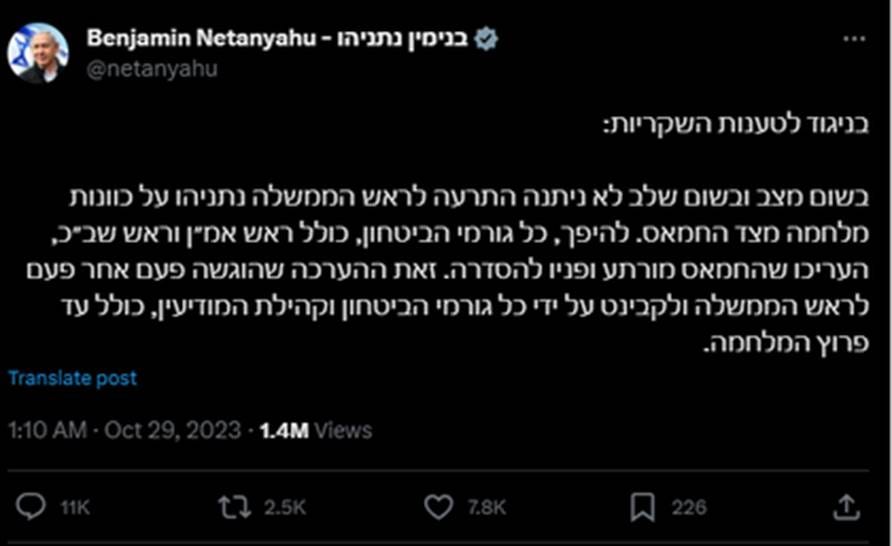
This attempt to deflect blame onto security officials provoked immediate and intense backlash from across Israel’s political and military spectrum. Benny Gantz, a minister and member of the war cabinet, responded that Netanyahu “must retract his remarks” and that “leadership requires showing responsibility.”99 Former IDF chief Gabi Ashkenazi also called on Netanyahu to remove the post.
Facing this barrage of criticism, Netanyahu deleted the controversial post and published a new tweet stating:100
I was wrong. The things I said following the press conference should not have been said, and I apologize for that. I fully support the heads of [Israel’s] security services.
Netanyahu’s attempt to blame security officials, followed by his forced retraction when faced with backlash, exemplifies a pattern of avoiding personal accountability while attempting to control the narrative about the October 7 failures. More importantly, it fits into a pattern of seeking to deny and minimize the extent of warnings that Israel, and even Netanyahu himself, had received. This behavior would continue in the months following the attack, as Netanyahu consistently resisted calls for a comprehensive investigation into the events leading up to October 7.
4.2 Censorship, self-censorship, and disappearing (or restricted) evidence?
The standard Israeli military censorship regime, already in place for decades, requires pre-publication submission of articles on security issues. After October 7, both the volume of submissions by journalists and censor interventions reached record highs.101 The censor has broad discretion to intervene when “real damage will be caused to the security of the state” which clearly is subject to wide interpretation. Media outlets are not allowed to indicate what has been censored within a story, nor indicate articles that have been barred entirely.
As Israeli society itself is hyper nationalistic and is perpetually on a war footing, there is also an internalized “information warfare” dimension effectively inculcated in media outlets and individuals. In many ways, self-censorship is more pervasive and widespread than official state-mandated censorship. It is literally impossible to know if there are critical angles relevant to this report, that are being actively – and even entirely – censored.
Another means of censorship are gag orders through the court system. The current prevalence and use – or abuse – of such orders is not available in any detail in recent years. A research paper102 and articles103 roughly a decade ago touched on this particular method of censorship – including their rising use and the risk of abuse. We are seeking comments on gag orders and censorship from Israeli journalists, and it is unclear if gag orders are also limiting information relevant to this report. In 2016 +972 noted the following:104
According to the figures revealed by Landau, 231 requests were submitted in 2015, as opposed to 186 in 2011 (more than a 20-percent increase). The proportion of the requests that have actually been upheld remains unknown, but the legal experts and journalists that she sampled were hard pressed to think of an instance where a request for a gag order has been rejected. Also, the number of gag orders that newspapers received roughly corresponds to the number of requests.
Israel society itself is markedly “right wing” on security matters, and this trend has been solidified and advanced over previous years and decades. The quite small “peace” or “anti-occupation” movement is generally ostracized socially and even viewed as a fifth column by many. They encounter general hostility which can even include physical violence. The few military and intelligence professionals who may want to dissent and reveal information in the public interest are generally cautious, could face serious criminal charges, and ultimately decide against disclosure. With a pervasive “siege” mentality, citizens, journalists, and media outlets exhibit many layers of self-censorship.
Reporters Without Borders have called for an end to the harassment and intimidation that journalists in Israel have been subjected to. Any outlet that is critical of Israeli policies, even in fairly mild terms, is generally targeted. They detailed the following one year after October 7, which serves as a representative example of the grave issues journalists and media outlets face:105
…on 13 October, BBC Arabic journalists Muhannad Tutunji and Haitham Abudiab and their crew were stopped, assaulted and held at gunpoint by the Israeli police in Tel Aviv. The police later claimed that they intervened because the BBC crew’s vehicle was suspicious, although it was marked with the letters “TV” and the journalists were equipped with bulletproof vests and helmets bearing the word “press.”
In an incident on 25 October, an Israeli citizen attacked a group of five photographers – Eyal Margolin of the daily Israel Hayom, Atef Safadi, the head of the European Press Agency (EPA), a photo agency in Israel, Jalaa Marey from Agence France-Presse, Fadi Amun from Haaretz and Sergey Ponomarev from the New York Times – near the Lebanese border. The journalists were photographing the Israeli army firing on Lebanon when the Israeli man approached, threatened them, and then physically attacked Margolin, breaking his arm. The assailant was initially arrested but was released a few hours later.
At least six other journalists – with the Qatari TV news channel Al-Jazeera, the Palestinian TV channel Mousawat, and Israeli media including Channel 12, Haaretz, and the Israel Broadcast Corporation – have been subjected to harassment or attacks by members of the public and authorities.
Haaretz reported that freelancer Israel Frey was threatened by dozens of far-right activists on 15 October for expressing concern about the number of civilians killed in Gaza.
A number of outlets have been banned from Israel outright since the conflict began. This removes critical access by foreign press, especially as some international outlets do not exhibit self-censorship. Note that Western mainstream outlets are overwhelmingly less critical of Israel and exhibit even greater self-censorship than dissident Israeli outlets. We are generally referring to non-Western mainstream outlets.
After the “war” on Gaza began, access to Gaza by international journalists has been blocked by Israel entirely – except for some “friendly” press embedded with the IDF. In addition, there have been over 200 journalists killed – some intentionally targeted and assassinated. It should be noted that while international journalists are unable to enter Gaza, there are hundreds of journalists who happen to be Gazan. The Arab world, and other international outlets, have used their services and reporting continually. Western mainstream media has seemingly chosen to pretend that these journalists effectively do not exist.
While researching we have spoken with Israelis who live in Israel, or Israelis who have emigrated. There is a general hesitancy to speak publicly on certain topics, including well-supported opinions, or even fact-based assessments. Hesitancy also applies to some Palestinians we have spoken with, for quite different reasons. These topics will be discussed in a future article. It should be noted that Roni Lifshitz, one of the tatzpitaniyot who spoke to ABC News, specifically noted that “she risks serious consequences in speaking to a news organization.” We are left to wonder what additional testimony we are not hearing, for a confluence of reasons.
An extremely opaque issue is the video, audio, and additional evidence from the day of the attack itself, and in the day leading up to the attack. Multiple sources have reported how recordings were deleted, moved, or access became “restricted.” In some cases, they had access for a period, and it was revoked as they began to assess the evidence and/or sought to share it with relevant parties. Further, it was reported that some communication recordings had a “disruption” on October 7. We urge you to read these sources in full for additional detail. The Jerusalem Post reported the following, after noting that the IDF states all the materials are “preserved and accessible to the relevant parties”:106
During a recent visit by senior IDF officers to various brigade headquarters, a troubling revelation came to light. It became apparent that surveillance camera footage along the Gaza border, dating back to the day the war with Hamas broke out, had mysteriously vanished. Furthermore, critical recordings from that Black Shabbat had been removed from the central database. These developments have raised suspicions and fueled a sense that everyone is primarily looking out for their own interests with an eye on what comes next. […]
Reserve officers also voiced their concerns about the apparent disappearance of crucial video footage.
These videos originated from various IDF surveillance cameras along the Gaza border, part of the military network known as “ZiTube.” The missing footage dated back to October 7 and seemed to have been deliberately removed to hinder in-depth investigation into events that transpired in Palestinian territory, border breaches, and the overall situation.
One senior reserve officer from a brigade recounted the situation, saying, “We had planned to show one of the key figures a video of a particular incident from last week, only to discover that someone had deleted the videos. […]
Sources within the Gaza Division also revealed a “disruption” in the recordings of communications from October 7.
According to these sources, “Some of the recordings have either disappeared or were simply downloaded from the network and relocated under the directives of commanding officers. Consequently, we are unable to access them.
“Communication recordings are typically deleted after a specific period, unless someone intentionally preserves them within the system, and there exists such a functionality,” the sources added. “It seems that someone made a deliberate choice to either transfer or delete these recordings to ensure that no one could listen to them.
In 2024, the families of victims had issues receiving full recordings. In particular, some recordings ended 12 hours before the Hamas invasion. The Times of Israel reported the following:107
Relatives of the surveillance soldiers told Hebrew media that they were only given the recordings from early in the morning of October 6 until that same evening. Hamas’s invasion of Israel began early on the morning of October 7.
Eyal Eshel, whose daughter, Roni, was on shift when the invasion began and could be heard in recordings released earlier announcing the first terrorists crossing the border, said he believed the army had lied to the families.
At first, he told Channel 12 News on Tuesday evening, the families were told the recordings had been destroyed in the attack, but that did not make sense to him because the Nahal Oz surveillance base was technologically advanced. The only reason he could think of for the army lying about the recordings was that it wanted to hide something, he added.
“They disregarded those girls before Saturday, October 7, they disregarded them that Saturday, they are disregarding us, the families, now. I guess we’re bothering them,” he said.
He added that he believed the IDF was trying to hide the fact that the surveillance soldiers warned of an impending attack before it began that morning but that they weren’t listened to.
Consider what direct observations presumably were made during the assembly and activation of approximately 3,000 militants in Gaza – beginning late on October 6th and especially prior to the attack itself. What warnings and communications were sent up the chain of command? How clear were they, and who did they reach? How was there no high alert reaction, to observations we must reasonably assume, occurred?
During the attack itself there was a horrifically delayed and ineffective IDF response. What were the specific communications from those under attack, or those observing and monitoring the attacks? The nature, timing, specificity, and particular individuals this information went to, is largely undisclosed. The IDF response, or more so lack of response, to these many communications may prove to be entirely inexplicable.
The level of suppression of evidence that would be relevant to this report is effectively unknowable. Nonetheless, evidence suppression appears to be occurring, on multiple levels.
We must acknowledge that there is unofficial self-censorship, official censorship, and state secrecy, that are all operating in a cumulative manner.
4.3 No comprehensive investigation – 2 and a half years and counting
Prime Minister Benjamin Netanyahu has resisted calls for a state commission of inquiry into the October 7 failures.108 Instead, he has consistently deferred a formal investigation until “after the conclusion of the war” – an open-ended timeline that effectively postpones accountability indefinitely. This stance contradicts Israel’s precedent following previous security failures, such as the 1973 Yom Kippur War, where a state commission of inquiry was established even as fighting continued.109
In his CNN interview, Netanyahu’s senior adviser Mark Regev stated: “We’ll have that investigation, but it has to be after the war.”110 This delaying tactic has been used for over two years to avoid accountability.
While the military and the Shin Bet have conducted their own internal investigations into the operational failures that led to the October 7 attack, these inquiries have been explicitly limited in scope and lack the independence and authority of a state commission.111 They have focused primarily on tactical and operational failures rather than a comprehensive review of the global failures, strategic decisions, and political responsibility.
Opposition figures in Israel have accused Netanyahu of using these limited internal investigations to shift blame onto the security services and away from political leadership. Yair Lapid, Israel’s opposition leader, directly accused Netanyahu of avoiding responsibility, stating in parliament: “The greatest disaster that has happened to the Jewish people since the Holocaust belongs to you. It will always belong to you.”112
Public opinion polls in Israel consistently show that a majority of Israelis support the establishment of a state commission of inquiry into the October 7 failures.113 This public demand for accountability has been met with resistance from Netanyahu’s government for over two years, suggesting fear of what such an investigation might reveal.
4.4 Feigned ignorance
The central pillar of Israel’s official narrative about the October 7 attack has been the claim that intelligence and military leaders “did not think Hamas wanted to attack” or lacked the “capability” to execute such an operation. This narrative of ignorance and misunderstanding has been consistently advanced, despite overwhelming evidence that unambiguously contradicts this. Both the intent and capabilities were known to Israel, and increasingly on public display.
Israeli officials claim that they fundamentally misunderstood Hamas’s intentions, believing the group was deterred and seeking accommodation rather than conflict.114 According to the Shin Bet’s own investigation, “Israel maintained a policy of calm with Hamas” based on the false assessment that Hamas was not interested in escalation.115 Similarly, the IDF’s investigation concluded that the attack was the result of years of false assessments about Hamas.116
This narrative of misunderstanding and misreading Hamas directly contradicts the extensive evidence of foreknowledge, training, warnings, and increasingly alarming actions documented throughout this report. Israeli intelligence possessed Hamas’s detailed battle plans for over a year before the attack, received dire warnings from Egyptian intelligence, observed unusual Hamas activities that mirrored the attack plans, and received reports from their own intelligence officers explicitly warning of an impending attack. The claim that Hamas’s intentions were simply “misunderstood” is difficult to reconcile with this large body of evidence.
Similarly, Israeli officials have claimed they underestimated Hamas’s capabilities, believing the group lacked the ability to execute a sophisticated attack.117 According to Israeli reports they “falsely thought Hamas was trying to inflame tensions in the Israeli-occupied West Bank, rather than maneuvering to invade Israel from Gaza.”118 We will dissect the trajectory of “inflamed tensions” in the West Bank in the year prior to October 7 elsewhere, but it is seriously debatable what “side” actually increased the bloodshed and violence in the West Bank. Jewish-Israeli settler attacks and terrorism – including outright murder of West Bank civilians – along with deadly IDF operations, had been growing steadily. On October 6th, just the day before the attack, settlers murdered a Palestinian woman in the West Bank.119 Netanyahu once stated quite explicitly in an interview how he controlled the “height of the flame” in the occupied territories, fairly explicitly indicating that the level of violence in the largely pacified West Bank was something that he dictated – not the occupied civilians. Hamas had very few assets or capabilities in the West Bank due to many years of separation.120
The narrative of feigned ignorance serves a critical purpose in the aftermath of October 7: it frames the attack as the result of an honest intelligence failure rather than deliberate negligence and engineered vulnerability. By claiming they simply didn’t know or understand, officials can avoid more serious questions about why they ignored explicit warnings, degraded intelligence capabilities, and reallocated defensive forces away from the Gaza border.
The feigned ignorance approach largely just consists of hand-waving dismissals, as people are continually forced to simply suspend their disbelief and ignore the large body of evidence. We do not intend to detail all aspects of it, but the Combating Terrorism Center at West Point did a fairly detailed report which, in opposition to the facts, takes the Israeli line.121 Their report should be read by interested parties. Even though it takes the official line, there are points where the authors show variable levels of disbelief.
5. Hamas – Strategic asset?
The relationship between Israel and Hamas has been far more complex than the simple enemy narrative often presented to the public. This section examines how elements within Israel’s political and military leadership, particularly under Netanyahu’s governance, have historically viewed and treated Hamas not merely as an adversary but as a strategic asset that served specific political objectives. Understanding this relationship is crucial for understanding how Hamas persisted and was continually strengthened. As discussed in the later motives section, the attacks may also just represent a new phase of Hamas as de facto political asset, just under a radically new paradigm.
5.1 Hamas as a strategic asset – formaldehyde for Palestinian freedom
For years, key figures in Israeli politics, including Prime Minister Benjamin Netanyahu, have viewed Hamas’s control of Gaza as strategically beneficial for Israel’s broader political objectives. This perspective was perhaps most explicitly articulated by Dov Weissglass, a senior advisor to former Prime Minister Ariel Sharon, who infamously described Israel’s Gaza disengagement plan as providing “the formaldehyde that is necessary so there will not be a political process with the Palestinians.”122 This “formaldehyde” strategy – keeping Palestinian politics divided and dysfunctional – became a cornerstone of Netanyahu’s approach to Hamas.
Israeli major general Gershon Hacohen, an associate of Prime Minister Benjamin Netanyahu, said in a 2019 interview with ynet:123
We need to tell the truth. Netanyahu’s strategy is to prevent the option of two states, so he is turning Hamas into his closest partner. Openly Hamas is an enemy. Covertly, it’s an ally.
This strategy was not merely rhetorical but translated into concrete policies. Major Israeli media have summarized the policy rationale. A summation of the policy in ynet noted the following, on October 7th itself:124
Since 2009, the Prime Minister has pursued a policy of divide and rule: weakening the PA in the West Bank, and granting immunity to Hamas rule in Gaza. The goal was to prevent an agreement with the Palestinians, which would cause him diplomatic and political damage.
…while the Olmert government led a policy that meant weakening the Strip and strengthening the PA in the West Bank, Netanyahu went in the opposite direction: weakening the PA and strengthening Hamas.
This perspective framed Hamas not as an existential threat but as a manageable problem that served useful political purposes. However, this strategy of using Hamas as formaldehyde naturally had a shelf life and could only enable the status quo for some period of time. Looking ahead any modest number of years, the divide and rule strategy would no longer be sustainable. Further, many Israelis and political elites were not abandoning their expansionist goals. Under Netanyahu the extremist settlers were consistently making gains, and the illegal settlements throughout the West Bank were continually expanding. However, something had to change to open a path for open annexation, rather than merely growing the illegal settlements and the settler population.
5.2 Suitcases of cash
Perhaps the most tangible manifestation of Israel’s complex relationship with Hamas was the regular transfer of millions of dollars in “Qatari” cash to Gaza, approved and facilitated, directly and explicitly, by Netanyahu’s government. These transfers, often literally carried in suitcases across the border, represented a stark contradiction to Israel’s public stance on Hamas as a terrorist organization.
Qatar reportedly supplied over $1 billion by multiple reports, and “at least $2 billion” according to the Times of Israel.125 These transfers were ostensibly for humanitarian purposes and to maintain “calm” along the border, but they effectively provided Hamas with significant financial resources. According to Israeli security officials, while some of this money went to civilian infrastructure and salaries, a substantial portion was diverted to Hamas’s military wing for weapons procurement and tunnel construction.126 Cash that Hamas received was inherently fungible, and Israel was keenly aware of the buildup of arms and military infrastructure.
Netanyahu personally approved these cash transfers despite opposition from security agencies and political rivals. In 2019, when criticized for allowing these transfers, Netanyahu defended the policy, with the Jerusalem Post summarizing a key aspect of his position as follows:127
The prime minister also said that, “whoever is against a Palestinian state should be for” transferring the funds to Gaza, because maintaining a separation between the PA in the West Bank and Hamas in Gaza helps prevent the establishment of a Palestinian state.
However, internal Israeli intelligence assessments had already warned that Hamas was diverting significant portions of this money to military purposes. Just weeks before the attack the head of Mossad, David Barnea, met with Qatari officials. The New York Times states the following regarding the meeting:128
During his meetings in September with the Qatari officials, according to several people familiar with the secret discussions, the Mossad chief, David Barnea, was asked a question that had not been on the agenda: Did Israel want the payments to continue?
Mr. Netanyahu’s government had recently decided to continue the policy, so Mr. Barnea said yes. The Israeli government still welcomed the money from Doha.
Allowing the payments – billions of dollars over roughly a decade – was a gamble by Mr. Netanyahu that a steady flow of money would maintain peace in Gaza, the eventual launching point of the Oct. 7 attacks, and keep Hamas focused on governing, not fighting.
The U.S. government was aware of and concerned about these transfers. According to diplomatic cables obtained by investigative journalists and released by WikiLeaks back in 2010, there was awareness of the support that came from Qatar.129 However, Israeli officials, at Netanyahu’s direction, lobbied Washington to prevent any public criticism of the arrangement.130
Former U.S. Ambassador to Israel, David Friedman, confirmed in his memoir that “Netanyahu insisted that allowing the Qatari money into Gaza was essential for preventing a humanitarian crisis that would force Israel into a war it didn’t want.”131 This rationale persisted even as Israeli intelligence agencies documented Hamas’s growing military capabilities and preparations for an attack. One can also propose that the opposite is true, and an expected “explosion” out of Gaza was precisely what some hoped to benefit from. Rather than maintenance of an ultimately unsustainable status quo, elites may have desired a large event that could unlock new paradigms, and various wider goals.
The Shin Bet’s post-October 7 investigation acknowledged that “Israel allowed Qatar to transfer millions of dollars to Hamas to fund its governing bureaucracy in Gaza. The money was diverted to Hamas’ military capabilities.”132 This is a stark acknowledgment of how Israeli policies directly contributed to Hamas’s ability to carry out the October 7 attack itself.
The cash transfers continued even as other warning signs accumulated. Recent reporting has indicated that Netanyahu was warned at least two times in the years before the attack that funds were diverted to Hams’s military wing.133 This decision, made at the highest levels of government, exemplifies how political considerations consistently overrode “security concerns” in Israel’s approach to Hamas.
The “suitcases of cash” policy reveals the profound contradiction at the heart of Israel’s relationship with Hamas under Netanyahu’s leadership. While publicly portraying Hamas as an implacable enemy, his government provided the group with financial resources that enhanced its capabilities and strengthened its position in Gaza – with their explicit knowledge. These contradictions are stark, and as cynical as the paradigm may be, we are forced to consider various motives and long-term strategic planning that may have been at play.
6. Multitude of motives
The evidence presented thus far raises profound questions, and strongly suggests that elements within Israel’s political and military leadership may have enabled or facilitated the October 7 attack – through a fairly widespread combination of both action and inaction.
This section examines potential motives that could explain this strategy, focusing on domestic political considerations, ideological commitments, aspirations within historic Palestine, and regional geopolitical calculations. While definitive conclusions about motivations require the kind of comprehensive investigation that Netanyahu has consistently resisted, understanding these potential motives is crucial for contextualizing the decisions that led to the attack and its aftermath.
6.1 Domestic concerns
In the months leading up to October 7, 2023, Prime Minister Benjamin Netanyahu faced unprecedented domestic political challenges that threatened both his leadership and his personal freedom. These challenges created a context in which a national security crisis might have served as a political lifeline.
Netanyahu’s government was facing massive public protests against its controversial judicial reform plan, which critics argued would undermine Israel’s institutions. These protests had been ongoing since January 2023 and grew to include an estimated half a million Israelis, with upwards of 240,000 participating in March in Tel Aviv alone.134
The protests had begun to affect Israel’s economy and international standing, with credit rating agencies warning of potential downgrades and foreign investment dropping off by 29% or more in 2023.135,136 Military reservists, including elite units critical for national security, had begun refusing service in protest against the judicial reforms, creating what former defense officials described as a significant security vulnerability. Roughly 10,000 reservists indicated they would “refuse to volunteer for duty if it was passed.”137
Simultaneously, Netanyahu was facing multiple corruption trials that could have resulted in prison time if convicted. The trials, which began in 2020, included charges of bribery, fraud, and breach of trust.138 Legal analysts and critics suggested that Netanyahu’s judicial reform push was partly motivated by a desire to shield himself from these legal proceedings.139
Netanyahu’s political coalition was also showing signs of strain, with far-right members pushing for more extreme policies while centrist elements expressed concern about the direction of the government. Polls conducted in September 2023 showed Netanyahu’s approval rating at historic lows, with only 28% of Israelis expressing confidence in his leadership.140 A majority of Israelis wanted his judicial reform scrapped, or negotiated with the opposition. Israelis were even polled in September 2023 on how they assessed the “likelihood of a civil war breaking out in Israel in the near future, which includes violence between the different sides.” A full 37.3 percent of Jewish Israelis thought such open violence had either a fairly high likelihood, or a very high likelihood.141
In this context, a national security crisis clearly offered potential political benefits. Historical precedent in Israel shows that during security crises, the public tends to rally around incumbent leadership, opposition criticism is muted, and domestic political disputes are temporarily set aside.142,143 With time this effect wears thin, and this may partially explain wider engagements directly with Iran that Israel overtly initiated. The waning support may even explain future events, or actions taken to perpetuate and/or widen the conflict.
The October 7 attack immediately halted the judicial reform protests, unified the political opposition behind the war effort, and effectively paused Netanyahu’s corruption trials. This cannot be discounted as a possible – and perhaps critical – political motivation.
6.2 Likud, Netanyahu, and the Revisionist Zionists: Demographic and territorial goals?
Beyond immediate political considerations, ideological factors may have influenced the decisions that enabled the October 7 attack. Put far more sharply – ideological reasons may have been the main reason that certain elites provoked the attacks and then overtly enabled them to succeed.
Netanyahu’s Likud party and its allies in the settler movement have strenuously opposed Palestinian statehood and advocated for Israeli control over the entirety of what they term “Greater Israel,” including the West Bank and Gaza. Absent massive conflict and significant changes on the ground, the status quo that had been maintained for years, was ultimately unsustainable – looking ahead any significant period of time.
The Likud party’s official platform explicitly rejects Palestinian statehood. Founding documents in 1977 asserted that “between the Sea and the Jordan there will only be Israeli sovereignty.”144 Likud and Netanyahu have openly and unambiguously rejected the establishment of a Palestinian state west of the Jordan river, and this has been reiterated with regularity. The current government established in 2022 – still in power and led by Netanyahu – stated the following in the opening lines of their “Basic Guidelines”:145
The Jewish people have an exclusive and inalienable right to all areas of the Land of Israel. The government will promote and develop settlement in all parts of the Land of Israel in the Galilee, the Negev, the Golan, Judea and Samaria. [translated from Hebrew]
This position reflects the party’s roots in Revisionist Zionism, an ideology that advocates for Jewish sovereignty over the entire “biblical Land of Israel.”
Netanyahu has repeatedly expressed opposition to Palestinian statehood, despite occasional rhetorical concessions due to international pressure. In a 2019 interview, he stated, “A Palestinian state will not be created, not like the one people are talking about. It won’t happen.”146 This position has been consistent throughout his political career, though sometimes obscured by diplomatic language when speaking to Western leaders or international media.
The October 7 attack and Israel’s subsequent military response in Gaza created conditions that significantly advanced ideological objectives related to these positions. The war has effectively ended any near-term prospects for Palestinian statehood, strengthened the position of settlement advocates, and created what some Israeli officials have described as an opportunity for “demographic changes” in Gaza. Over the past two years there have been many statements which implicitly or explicitly indicated a plan to partially, or completely, depopulate the Gaza strip. The Times of Israel outlined statements by the Finance Minister Bezalel Smotrich in May 2025:147
Far-right Finance Minister Bezalel Smotrich shared his vision for the Gaza Strip on Tuesday, predicting that within half a year, the population of the territory would be confined to just a narrow swath of land, with the remainder of the enclave “totally destroyed.”
In remarks at a “Settlements Conference” organized by the Makor Rishon newspaper in the West Bank settlement of Ofra, Smotrich also declared that Israel would “apply sovereignty” in the West Bank within the lifetime of the current government, which is due to expire in October 2026, unless elections are called earlier. […]
He told the listening audience that the population of Gaza, some 2.3 million Palestinians, would be “concentrated” in a narrow strip of land between the Egyptian border and the so-called Morag Corridor, which runs the width of Gaza between Khan Younis and the border city of Rafah. […]
He did not elaborate how confining all of Gaza’s war-battered population into a narrow strip without the ability to leave would be a humanitarian act, but added: “They will be totally despairing, understanding that there is no hope and nothing to look for in Gaza, and will be looking for relocation to begin a new life in other places.”
Heritage Minister Amichai Eliyahu went further, suggesting that dropping a nuclear bomb on Gaza was “one option.”148 While Netanyahu distanced himself from these specific comments, they reflect the ideological currents within his government that have benefited from the post-October 7 situation. There is a long list of quotes from Israeli leadership that explicitly or implicitly advocated for genocide, mass expulsion, or other crimes.149
In the West Bank some villages have been entirely depopulated, thousands of homes have been demolished, many Palestinians have been displaced, and settlements have been expanded dramatically since the attacks.150, 151, 152 In an overt move, the Israeli parliament has begun passing legislation that leads towards formal – illegal – annexation of the West Bank.153
Opinion polls in Israel have taken a drastic shift since the attacks, with over 80% approving the expulsion of Gaza’s population, and a majority even supporting expulsion of “Arab-Israelis” from Israel proper.154 Arab-Israelis are Palestinians who are citizens of Israel, and were not victims of the mass expulsions and dispossessions in 1947-1949, or subsequent acts of expulsion.
The attack and its aftermath have also strengthened Netanyahu’s political alliance with the settler movement and religious nationalist parties, which had been crucial for his return to power but were proving difficult to manage before October 7. The national unity created by the war has allowed Netanyahu to maintain this coalition while temporarily neutralizing more moderate political opposition.
7. Conclusion
The evidence presented in this paper paints a disturbing picture of the events leading up to, during, and following, the October 7 attack on Israel. Far from being an unpredictable surprise attack that caught Israeli authorities completely unaware, the evidence suggests a clear pattern of deliberate actions and inactions overtly facilitated success.
Israeli intelligence possessed Hamas’s detailed battle plans for over a year before the attack, received explicit warnings from Egyptian intelligence services, observed unusual Hamas activities that mirrored these plans, and received reports from their own intelligence officers warning of an impending attack. Despite this wealth of foreknowledge, no effective preventive measures were taken.
Additionally, in the period leading up to October 7, Israeli authorities systematically weakened defenses along the Gaza border by redeploying troops away from the area, degrading intelligence capabilities, and approving a large civilian gathering near the border despite explicit security concerns. During the attack itself, communication systems failed, and military responses were inexplicably delayed, allowing Hamas to continue its assault for hours without effective opposition.
In the aftermath, Israeli political leaders, particularly Prime Minister Benjamin Netanyahu, have resisted accountability through denials, censorship of information about the attack, resistance to independent investigations, and the promotion of an unsustainable narrative of feigned ignorance.
The timing of the attack, coming when Netanyahu faced unprecedented domestic political challenges, raises additional questions about potential motives. The attack immediately halted massive protests against Netanyahu’s judicial reforms, unified the political opposition behind the war effort, paused his corruption trials, and created conditions that advanced the ideological objectives of his far-right coalition partners.
The overt incompatibility of the longstanding Netanyahu and Likud position that no Palestinian state would ever exist west of the Jordan River, with the overwhelming international consensus that a sovereign Palestine must be established, is stark. Likud and maximalist Zionists had an unsustainable position in the longer term, as they had no way to “digest” the Palestinians they ruled over. They were unwilling to relinquish the illegally occupied West Bank for a Palestinian state, yet also unwilling to offer them equality and citizenship.
While these proposed motives – a partial list – do not prove intent, they provide context for understanding why certain elements within Israel’s political and military leadership might have viewed the attack as creating political opportunities, despite the immediate costs.
The victims of October 7 – both those killed and taken hostage in the initial attack and far more affected by the subsequent “wars” – deserve a full accounting of how and why this tragedy was allowed to occur. The systematic suppression of information and accountability suggests that powerful interests within Israel are determined to prevent such an accounting.
The evidence presented here demands a comprehensive independent investigation into the decisions that enabled the October 7 attack – an investigation that Netanyahu has consistently resisted. As such an investigation appears increasingly unlikely, and could simply be a continuation of the cover-up, a diligent open-source intelligence (OSINT) investigation is warranted. This investigation must be bolstered by individuals providing expertise, and direct evidence and testimony, however able.
Israelis and members of foreign governments should also move to expose suppressed and censored information. It is believed that politicians and intelligence professionals have significant evidence that has been suppressed, censored, and improperly and/or illegally classified. Outside of Israel, individuals in the US, UK, and Egypt have a duty to act. It is believed that damning evidence exists, even with these foreign governments.
Above all, patriotic Israelis who seek truth and justice, and want to come forward with their respective testimony, should pursue disclosure. The path that extremist elites have been charting most likely ends in even greater disasters for Israelis, Palestinians, the region, and perhaps far beyond.
The victims of October 7 – both those killed and taken hostage in the initial attack and so many more affected by the subsequent “wars” – deserve a full accounting of how and why this tragedy was allowed to occur.
To allow this charade to continue is unconscionable. Both peoples in the region, Israelis and Palestinians, can only benefit from decisive open exposure on this issue. Only those who seek to abuse power and pursue policies of subjugation, and even ethnic cleansing, have an interest in suppressing the truth. Lies, fear, and hate – these ills hopelessly imprison all who are inculcated with them. Only exposure and accountability can begin to free all the diverse people, currently living in the region.
Thank you for reading. If you would like to take productive action, please become a free subscriber, and visit out October 7 project tracker. Get involved, comment, share, or do anything you can!
Also consider becoming a paid member at $3.50 per month. We promise you will appreciate our content that will come. Paid membership gets access to teleconferences, chats/comments, free book giveaways each month, and more. 20% of all Substack revenue will be donated in turn to The Palestine Children’s Relief Fund (PCRF) on a regular basis.
We started this research and report before the one year anniversary of October 7th, in 2024. We spent a lot of time. A lot. A simple tip, large or small, helps defray costs from subscriptions and much else. We even had a week in Cairo speaking with some Gazans who fled. We will anonymize them, but will share some of their experiences in time. Thank you, shukran, toda, gracias, danke, merci, etc.!
References
The New York Times. (2023, November 30). “Israel Knew Hamas’s Attack Plan Over a Year Ago.” https://www.nytimes.com/2023/11/30/world/middleeast/israel-hamas-attack-intelligence.html
NPR. (2025, March 5). “What went wrong? Israel’s spy agency lists failures in preventing Oct. 7 attack.” https://www.npr.org/2025/03/05/nx-s1-5318591/israel-shin-bet-security-failure-october-7-attack
Times of Israel. (2023, December 1). “Israel had Hamas’s October 7 battle plan for a year but dismissed it — report.” https://www.timesofisrael.com/liveblog_entry/israel-had-hamass-october-7-battle-plan-for-a-year-but-dismissed-it-report/
The New York Times. (2023, November 30). “Israel Knew Hamas’s Attack Plan Over a Year Ago.” https://www.nytimes.com/2023/11/30/world/middleeast/israel-hamas-attack-intelligence.html
Combating Terrorism Center at West Point. (2024, October). “The October 7 Attack: An Assessment of the Intelligence Failings.” https://ctc.westpoint.edu/the-october-7-attack-an-assessment-of-the-intelligence-failings/
Combating Terrorism Center at West Point. (2024, October). “The October 7 Attack: An Assessment of the Intelligence Failings.” https://ctc.westpoint.edu/the-october-7-attack-an-assessment-of-the-intelligence-failings/
CNN. (2023, December 1). “Mark Regev Interview - Jericho Wall Document.” CNN Erin Burnett OutFront. https://www.cnn.com/videos/world/2023/12/02/mark-regev-israel-october-5-intelligence-sot-ebof-vpx.cnn (also on YouTube ..
PBS. (2023, October 27). “Colonel Miri Eisen Interview.” Amanpour and Company. https://www.pbs.org/video/october-27-2023-hp3fda/
NPR. (2025, March 5). “What went wrong? Israel’s spy agency lists failures in preventing Oct. 7 attack.” https://www.npr.org/2025/03/05/nx-s1-5318591/israel-shin-bet-security-failure-october-7-attack
Politico. (2023, November 21). “Our warnings on Hamas were ignored, Israel’s women border troops say.” https://www.politico.eu/article/israel-border-troops-women-hamas-warnings-war-october-7-benjamin-netanyahu/
The Guardian. (2023, October 12). “Egypt warned Israel of Hamas attack days earlier, senior US politician says.” https://www.theguardian.com/world/2023/oct/12/israel-hamas-war-egypt-warned-foreign-affairs-gaza
The Guardian. (2023, October 12). “Egypt warned Israel of Hamas attack days earlier, senior US politician says.” https://www.theguardian.com/world/2023/oct/12/israel-hamas-war-egypt-warned-foreign-affairs-gaza
BBC. (2023, October 12). “Egypt warned Israel days before Hamas struck, US committee chairman says.” https://www.bbc.com/news/world-middle-east-67082047
The Guardian. (2023, October 12). “Egypt warned Israel of Hamas attack days earlier, senior US politician says.” https://www.theguardian.com/world/2023/oct/12/israel-hamas-war-egypt-warned-foreign-affairs-gaza
The Guardian. (2023, October 12). “Egypt warned Israel of Hamas attack days earlier, senior US politician says.” https://www.theguardian.com/world/2023/oct/12/israel-hamas-war-egypt-warned-foreign-affairs-gaza
Times of Israel. (2023, October 9). “Egypt intelligence official says Israel ignored repeated warnings of ‘something big’.” https://www.timesofisrael.com/egypt-intelligence-official-says-israel-ignored-repeated-warnings-of-something-big/
Politico. (2023, November 21). “Our warnings on Hamas were ignored, Israel’s women border troops say.” https://www.politico.eu/article/israel-border-troops-women-hamas-warnings-war-october-7-benjamin-netanyahu/
BBC. (2024, January 14). “They were Israel’s ‘eyes on the border’ - but their Hamas warnings were ignored.” https://www.bbc.com/news/world-middle-east-67958260
PBS. (2024, October 9). “IDF Ignored Female Soldiers’ Warnings Pre-Oct. 7. Then They Were Massacred.” Amanpour and Company. www.youtube.com/watch?v=dELb5wVQwbk
Politico. (2023, November 21). “Our warnings on Hamas were ignored, Israel’s women border troops say.” https://www.politico.eu/article/israel-border-troops-women-hamas-warnings-war-october-7-benjamin-netanyahu/
Politico. (2023, November 21). “Our warnings on Hamas were ignored, Israel’s women border troops say.” https://www.politico.eu/article/israel-border-troops-women-hamas-warnings-war-october-7-benjamin-netanyahu/
ABC News. (2024, June 28). “IDF soldiers say repeated warnings of Hamas activity prior to Oct. 7 attacks were ignored” https://abcnews.go.com/International/idf-soldiers-repeated-warnings-hamas-activity-prior-oct/story?id=111312207
Haaretz. (2024, June 18). “Report: New Evidence Reveals IDF Had Detailed Prior Knowledge of Hamas Plan to Raid Israel.” https://www.haaretz.com/israel-news/2024-06-18/ty-article/report-new-evidence-reveals-idf-had-detailed-prior-knowledge-of-hamas-plan-to-raid-israel/00000190-2afb-d2de-af9e-6ffbdf700000
Times of Israel. (2024, July 5). “‘The sword is coming’: Biblical IDF email warned of Hamas plans days before Oct.7” https://www.timesofisrael.com/the-sword-is-coming-idf-email-warned-of-hamas-plans-days-before-oct-7-report/
Times of Israel. (2023, November 24). “Reports: Senior IDF officer dismissed pre-Oct. 7 intel on Hamas invasion as ‘fantasy’.” https://www.timesofisrael.com/reports-senior-idf-officer-dismissed-pre-oct-7-intel-on-hamas-invasion-as-fantasy/
Times of Israel. (2023, November 28). “Top Israeli intel unit wasn’t operational on October 7 due to personnel decision.” https://www.timesofisrael.com/top-israeli-intel-unit-wasnt-operational-on-october-7-due-to-personnel-decision/
Times of Israel. (2023, November 24). “Reports: Senior IDF officer dismissed pre-Oct. 7 intel on Hamas invasion as ‘fantasy’.” https://www.timesofisrael.com/reports-senior-idf-officer-dismissed-pre-oct-7-intel-on-hamas-invasion-as-fantasy/
Times of Israel. (2025, February 27). “IDF identified but ignored 5 warning signs of Hamas attack on eve of Oct. 7, its probe shows.” https://www.timesofisrael.com/idf-identified-but-ignored-5-warning-signs-of-hamas-attack-on-eve-of-oct-7-its-probe-shows/
Times of Israel. (2025, February 27). “IDF identified but ignored 5 warning signs of Hamas attack on eve of Oct. 7, its probe shows.” https://www.timesofisrael.com/idf-identified-but-ignored-5-warning-signs-of-hamas-attack-on-eve-of-oct-7-its-probe-shows/
Britannica. (2026, May 25). “12-Day War.” https://www.britannica.com/event/12-Day-War
NY Times. (2024, December 29). “Behind the Dismantling of Hezbollah: Decades of Israeli Intelligence.” https://www.nytimes.com/2024/12/29/world/middleeast/israel-hezbollah-nasrallah-assassination-intelligence.html
Jewish Virtual Library. “The Mista’arvim.” https://jewishvirtuallibrary.org/the-mista-arvim
Associated Press. (2018, December 12). “Palestinians offer new details of Israel’s botched Gaza raid.” https://apnews.com/article/2d41ab217cb0401c991ad3a6bfe8818e
Combating Terrorism Center at West Point. (2024, October). “The October 7 Attack: An Assessment of the Intelligence Failings.” https://ctc.westpoint.edu/the-october-7-attack-an-assessment-of-the-intelligence-failings/
Times of Israel. (2025, February 27). “IDF identified but ignored 5 warning signs of Hamas attack on eve of Oct. 7, its probe shows.” https://www.timesofisrael.com/idf-identified-but-ignored-5-warning-signs-of-hamas-attack-on-eve-of-oct-7-its-probe-shows/
Middle East Eye. (2021, November 15). “Israel can monitor every telephone call in West Bank and Gaza, says intelligence source.” https://www.middleeasteye.net/news/israel-can-monitor-every-telephone-call-west-bank-and-gaza-intelligence-source
Guardian. (2025, August 6). “‘A million calls an hour’: Israel relying on Microsoft cloud for expansive surveillance of Palestinians.” https://www.theguardian.com/world/2025/aug/06/microsoft-israeli-military-palestinian-phone-calls-cloud
World Israel News. (2024, February 6). “IDF heard about Hamas invasion a week before October 7th, security head reveals.” https://worldisraelnews.com/idf-heard-about-hamas-invasion-a-week-before-october-7th-security-head-reveals/
VINnews. (2024, February 6). “Security Officer At Nova Festival: ‘I Was Warned Something Might Happen On Sukkot.’” https://vinnews.com/2024/02/06/security-officer-at-nova-festival-i-was-warned-something-might-happen-on-sukkot/
SSRN Columbia Law School. (2023, December 4). “Trading on Terror?” https://papers.ssrn.com/sol3/papers.cfm?abstract_id=4652027
CNN. (2023, December 4). “Unknown traders appear to have anticipated October 7 Hamas attack, research finds.” https://edition.cnn.com/2023/12/04/business/some-traders-appear-to-have-anticipated-october-7-hamas-attack-research-finds
MintPress News, (2023, December 7). “Just Like 9/11? Suspicious Israeli Stock Market Activity Hints at Foreknowledge of October 7 Attack.” https://www.mintpressnews.com/just-like-9-11-israeli-stock-market-trends-hint-at-foreknowledge-of-operation-al-aqsa-flood/286407/
Electronic Intifada. (2025, September 25). “Who profited off 7 October?” https://electronicintifada.net/content/who-profited-7-october/50963
Reuters. (2023, December 5). “Tel Aviv bourse says no unusual trading ahead of Oct 7 Hamas attack” https://www.reuters.com/world/middle-east/tel-aviv-bourse-says-no-unusual-trading-ahead-oct-7-hamas-attack-2023-12-05/
SSRN Columbia Law School. (2023, December 4). “Trading on Terror?” https://papers.ssrn.com/sol3/papers.cfm?abstract_id=4652027
The Economist. (2023, December 8). “Who made millions from the attack on Israel? Unusual activity in New York markets has sparked speculation” https://www.economist.com/films/2023/12/08/who-made-millions-from-the-attack-on-israel
Wall Street Journal. (2023, December 12). “Videos Show Hamas Trained for Oct. 7 Attack in Plain Sight for Years | WSJ.” Link
Le Monde. (2023, October 30). “Hamas attack: October 7, a day of hell on earth in Israel.” https://www.lemonde.fr/en/international/article/2023/10/30/hamas-attack-october-7-a-day-of-hell-on-earth-in-israel_6213560_4.html#
New Lines Magazine. (2024, May 20). “How Changes in the Israeli Military Led to the Failure of October 7.” https://newlinesmag.com/argument/how-changes-in-the-israeli-military-led-to-the-failure-of-october-7/
New Lines Magazine. (2024, May 20). “How Changes in the Israeli Military Led to the Failure of October 7.” https://newlinesmag.com/argument/how-changes-in-the-israeli-military-led-to-the-failure-of-october-7/
New Lines Magazine. (2024, May 20). “How Changes in the Israeli Military Led to the Failure of October 7.” https://newlinesmag.com/argument/how-changes-in-the-israeli-military-led-to-the-failure-of-october-7/
New Lines Magazine. (2024, May 20). “How Changes in the Israeli Military Led to the Failure of October 7.” https://newlinesmag.com/argument/how-changes-in-the-israeli-military-led-to-the-failure-of-october-7/
Business Insider. (2023, October 30). “Israel stopped monitoring Hamas’ radio comms a year ago because they thought it was a waste of time: New York Times.” https://www.businessinsider.com/israel-stopped-monitoring-hamas-radio-comms-last-year-nyt-report-2023-10
The New York Time. (2023, October 29). “How Years of Israeli Failures on Hamas Led to a Devastating Attack” https://www.nytimes.com/2023/10/29/world/middleeast/israel-intelligence-hamas-attack.html
Times of Israel. (2023, November 28). “Top Israeli intel unit wasn’t operational on October 7 due to personnel decision.” https://www.timesofisrael.com/top-israeli-intel-unit-wasnt-operational-on-october-7-due-to-personnel-decision/
Times of Israel. (2023, November 28). “Top Israeli intel unit wasn’t operational on October 7 due to personnel decision.” https://www.timesofisrael.com/top-israeli-intel-unit-wasnt-operational-on-october-7-due-to-personnel-decision/
BBC. (2024, October 4). “Six hours at hands of Hamas - new accounts reveal how Israeli base fell on 7 October.” https://www.bbc.com/news/articles/cg7825rk8j9o
Times of Israel. (2024, September 17). “IDF surveillance troops testify to glitches, neglect, no warfare training before Oct. 7.” https://www.timesofisrael.com/idf-surveillance-troops-testify-to-glitches-neglect-no-warfare-training-before-oct-7/
BBC. (2024, October 4). “Six hours at hands of Hamas - new accounts reveal how Israeli base fell on 7 October.” https://www.bbc.com/news/articles/cg7825rk8j9o
You’re the Voice – Efrat Fenigson. (2023, November 22). “Raphael Hayon’s Story: A Silenced Mission.” Link
Find new working link ˆ
Jerusalem Post. (2025, March 24). “Hamas is becoming more dangerous every day, citizen who warned of Oct. 7 says.” https://www.jpost.com/israel-news/politics-and-diplomacy/article-847307
Haaretz. (2025, September 17). “Month Before Oct. 7 Nova Massacre, Israeli Police Banned Events Near Gaza Border.” https://www.haaretz.com/israel-news/2025-09-17/ty-article/.premium/month-before-oct-7-nova-massacre-israeli-police-banned-events-near-gaza-border/00000199-57ce-d0dc-afdb-d7ff89750000
Haaretz. (2025, September 17). “Month Before Oct. 7 Nova Massacre, Israeli Police Banned Events Near Gaza Border.” https://www.haaretz.com/israel-news/2025-09-17/ty-article/.premium/month-before-oct-7-nova-massacre-israeli-police-banned-events-near-gaza-border/00000199-57ce-d0dc-afdb-d7ff89750000
Haaretz. (2023, December 25). “’Needless Security Risk’: Israeli Army Approved Nova Festival Despite Senior Officer’s Alarm.” https://www.haaretz.com/israel-news/2023-12-25/ty-article/.premium/idf-allowed-rave-later-attacked-by-hamas-despite-key-officers-concern/0000018c-9d78-ddc3-a1bf-bf7edca30000
Haaretz. (2023, December 5). “‘This Massacre Should Have Been Prevented’ Despite Israeli Intelligence Warnings About a Hamas Attack, the Army Didn’t Evacuate the Nova Festival.” https://www.haaretz.com/israel-news/2023-12-05/ty-article/.premium/despite-intel-warnings-about-a-hamas-attack-the-army-didnt-evacuate-the-nova-festival/0000018c-3993-dc03-a9ec-3dfb2cda0000
Haaretz. (2025, September 2). “Top IDF Commander Opted Not to Boost Security After Visiting Nova One Hour Before October 7 Hamas Massacre.” https://www.haaretz.com/israel-news/2025-09-02/ty-article/.premium/top-idf-commander-ignored-risks-after-visiting-nova-mere-hour-before-oct-7-hamas-massacre/00000199-09f0-d21e-a9db-1bfbe01b0000
Times of Israel. (2024, January 1). “42 survivors of the Nova rave massacre sue defense establishment for negligence.” https://www.timesofisrael.com/42-survivors-of-the-nova-rave-massacre-sue-defense-establishment-for-negligence/
New Lines Magazine. (2024, May 20). “How Changes in the Israeli Military Led to the Failure of October 7.” https://newlinesmag.com/argument/how-changes-in-the-israeli-military-led-to-the-failure-of-october-7/
BBC. (2024, October 4). “Questions for IDF over fall of Israel border post Nahal Oz by Hamas on 7 October.” https://www.bbc.com/news/articles/cg7825rk8j9o
ynet. (2024, November 9). “Air Force commander unaware of Nova massacre until hours into attack, report says.” https://www.ynetnews.com/article/hjxtycjp0
New Lines Magazine. (2024, May 20). “How Changes in the Israeli Military Led to the Failure of October 7.” https://newlinesmag.com/argument/how-changes-in-the-israeli-military-led-to-the-failure-of-october-7/
BBC. (2024, October 4). “Questions for IDF over fall of Israel border post Nahal Oz by Hamas on 7 October.” https://www.bbc.com/news/articles/cg7825rk8j9o
New Lines Magazine. (2024, May 20). “How Changes in the Israeli Military Led to the Failure of October 7.” https://newlinesmag.com/argument/how-changes-in-the-israeli-military-led-to-the-failure-of-october-7/
New Lines Magazine. (2024, May 20). “How Changes in the Israeli Military Led to the Failure of October 7.” https://newlinesmag.com/argument/how-changes-in-the-israeli-military-led-to-the-failure-of-october-7/
BBC. (2024, October 4). “Questions for IDF over fall of Israel border post Nahal Oz by Hamas on 7 October.” https://www.bbc.com/news/articles/cg7825rk8j9o
New Lines Magazine. (2024, May 20). “How Changes in the Israeli Military Led to the Failure of October 7.” https://newlinesmag.com/argument/how-changes-in-the-israeli-military-led-to-the-failure-of-october-7/
BBC. (2024, October 4). “Questions for IDF over fall of Israel border post Nahal Oz by Hamas on 7 October.” https://www.bbc.com/news/articles/cg7825rk8j9o
World Israel News. (2025, September 14). “IDF helicopter saw Hamas invasion on Oct. 7 but didn’t intervene – report.” https://worldisraelnews.com/idf-helicopter-saw-hamas-invasion-on-oct-7-but-didnt-intervene-report/
New Lines Magazine. (2024, May 20). “How Changes in the Israeli Military Led to the Failure of October 7.” https://newlinesmag.com/argument/how-changes-in-the-israeli-military-led-to-the-failure-of-october-7/
NBC News. (2024, July 12). “Israeli military abandoned kibbutz for hours during Hamas’ attack Oct. 7, IDF inquiry finds.” https://www.nbcnews.com/news/world/israeli-military-kibbutz-internal-inquiry-rcna161497
Combating Terrorism Center at West Point. (2024, October). “The October 7 Attack: An Assessment of the Intelligence Failings.” https://ctc.westpoint.edu/the-october-7-attack-an-assessment-of-the-intelligence-failings/
BBC. (2024, October 4). “Six hours at hands of Hamas - new accounts reveal how Israeli base fell on 7 October.” https://www.bbc.com/news/articles/cg7825rk8j9o
Find Haaretz link ˆ
PROJECTPENS. (2026, May 31). “The October 7 dissenters: A massive military and intelligence failure, or something else?” Link.
Part of the Problem with Dave Smith. (2025, October 5). “Col. Douglas MacGregor | Part Of The Problem 1311.” Link.
The Deep Focus Show. (2025, October 31). “Rethinking U.S. Global Domination with Col. Douglas Macgregor.” Link.
Haaretz. (2024, July 7). “IDF Ordered Hannibal Directive on October 7 to Prevent Hamas Taking Soldiers Captive.” https://www.haaretz.com/israel-news/2024-07-07/ty-article-magazine/.premium/idf-ordered-hannibal-directive-on-october-7-to-prevent-hamas-taking-soldiers-captive/00000190-89a2-d776-a3b1-fdbe45520000
Electronic Intifada. (2023, November). “Israeli helicopter shot civilians at 7 October rave, police find.” https://electronicintifada.net/blogs/ali-abunimah/israeli-helicopter-shot-civilians-7-october-rave-police-find
Times of Israel. (2024, July 4). “IDF officers invoked defunct ‘Hannibal Protocol’ during Oct. 7 fighting, report.” https://www.timesofisrael.com/idf-officers-invoked-defunct-hannibal-protocol-during-oct-7-fighting-report/
Haaretz. (2024, July 7). “IDF Ordered Hannibal Directive on October 7 to Prevent Hamas Taking Soldiers Captive.” https://www.haaretz.com/israel-news/2024-07-07/ty-article-magazine/.premium/idf-ordered-hannibal-directive-on-october-7-to-prevent-hamas-taking-soldiers-captive/00000190-89a2-d776-a3b1-fdbe45520000
NBC News. (2024, ). “Israeli military abandoned kibbutz for hours during Hamas’ attack Oct. 7, IDF inquiry finds.” https://www.nbcnews.com/news/world/israeli-military-kibbutz-internal-inquiry-rcna161497
Mondoweiss. (2024, October 22). “How the UN Commission of Inquiry Report on October 7 launders Israeli propaganda.” https://mondoweiss.net/2024/10/how-the-un-commission-of-inquiry-report-on-october-7-launders-israeli-propaganda/
Le Monde. (2024, April 3). “‘40 beheaded babies’: Deconstructing the rumor at the heart of the information battle between Israel and Hamas.” https://www.lemonde.fr/en/les-decodeurs/article/2024/04/03/40-beheaded-babies-the-itinerary-of-a-rumor-at-the-heart-of-the-information-battle-between-israel-and-hamas_6667274_8.html
Haaretz. (2023, October 29). “After Fury, Netanyahu Deletes, Apologizes for Post Blaming Security Chiefs for Hamas Attack.” https://www.haaretz.com/israel-news/2023-10-29/ty-article/after-drawing-fury-netanyahu-deletes-tweet-blaming-security-chiefs-for-hamas-attack/0000018b-7a77-d4a8-a3cf-feff35d20000
Haaretz. (2023, October 29). “After Fury, Netanyahu Deletes, Apologizes for Post Blaming Security Chiefs for Hamas Attack.” https://www.haaretz.com/israel-news/2023-10-29/ty-article/after-drawing-fury-netanyahu-deletes-tweet-blaming-security-chiefs-for-hamas-attack/0000018b-7a77-d4a8-a3cf-feff35d20000
Haaretz. (2023, October 29). “After Fury, Netanyahu Deletes, Apologizes for Post Blaming Security Chiefs for Hamas Attack.” https://www.haaretz.com/israel-news/2023-10-29/ty-article/after-drawing-fury-netanyahu-deletes-tweet-blaming-security-chiefs-for-hamas-attack/0000018b-7a77-d4a8-a3cf-feff35d20000
+972. (2024, May 20). “Israeli military censor bans highest number of articles in over a decade” https://www.972mag.com/israeli-military-censor-media-2023/
Reuters Institute for the Study of Journalism – Noa Landau. (2016, July). “The State vs the Press - The Rise of Gag Orders in Israel.” https://reutersinstitute.politics.ox.ac.uk/our-research/state-vs-press-rise-gag-orders-israel
+972. (2016, August 9). “How Israel is trying to enforce gag orders beyond its borders.” https://www.972mag.com/how-israel-is-trying-to-enforce-gag-orders-beyond-its-borders/
+972. (2016, May 9). “Gag orders in Israel have tripled over last 15 years.” https://www.972mag.com/gag-orders-in-israel-have-tripled-over-last-15-years/
Reporters Without Border - RSF. (2024, October 4). “Pressure, intimidation, and censorship: Israeli journalists have faced growing repression in the past year.” https://rsf.org/en/pressure-intimidation-and-censorship-israeli-journalists-have-faced-growing-repression-past-year
Jerusalem Post. (2023, December 3) [posted 13:27, updated 18:42]. “Critical IDF surveillance videos from Hamas’s attack on Oct. 7 missing.” https://www.jpost.com/arab-israeli-conflict/article-776318
Times of Israel. (2024, December 24). “Katz orders IDF to release full October 7 recordings of slain surveillance soldiers; Soldiers’ families in uproar after being supplied with apparent partial recordings that end 12 hours before Hamas invasion, in which some soldiers are not heard at all.” https://www.timesofisrael.com/katz-orders-idf-to-release-full-october-7-recordings-of-slain-surveillance-soldiers/
NPR. (2025, March 5). “What went wrong? Israel’s spy agency lists failures in preventing Oct. 7 attack.” https://www.npr.org/2025/03/05/nx-s1-5318591/israel-shin-bet-security-failure-october-7-attack
Shapira, I. (2023). “The Yom Kippur intelligence failure after fifty years: what lessons can be learned? Intelligence and National Security”, 38(6), 978 – 1002. https://doi.org/10.1080/02684527.2023.2235795
CNN. (2023, December 1). “Mark Regev Interview - Jericho Wall Document.” CNN Erin Burnett OutFront. https://www.cnn.com/videos/world/2023/12/02/mark-regev-israel-october-5-intelligence-sot-ebof-vpx.cnn
NPR. (2025, March 5). “What went wrong? Israel’s spy agency lists failures in preventing Oct. 7 attack.” https://www.npr.org/2025/03/05/nx-s1-5318591/israel-shin-bet-security-failure-october-7-attack
NPR. (2025, March 5). “What went wrong? Israel’s spy agency lists failures in preventing Oct. 7 attack.” https://www.npr.org/2025/03/05/nx-s1-5318591/israel-shin-bet-security-failure-october-7-attack
NPR. (2025, March 5). “What went wrong? Israel’s spy agency lists failures in preventing Oct. 7 attack.” https://www.npr.org/2025/03/05/nx-s1-5318591/israel-shin-bet-security-failure-october-7-attack
NPR. (2025, March 5). “What went wrong? Israel’s spy agency lists failures in preventing Oct. 7 attack.” https://www.npr.org/2025/03/05/nx-s1-5318591/israel-shin-bet-security-failure-october-7-attack
NPR. (2025, March 5). “What went wrong? Israel’s spy agency lists failures in preventing Oct. 7 attack.” https://www.npr.org/2025/03/05/nx-s1-5318591/israel-shin-bet-security-failure-october-7-attack
Times of Israel. (2023). “IDF identified but ignored 5 warning signs of Hamas attack on eve of Oct. 7, its probe shows.” https://www.timesofisrael.com/idf-identified-but-ignored-5-warning-signs-of-hamas-attack-on-eve-of-oct-7-its-probe-shows/
Combating Terrorism Center at West Point. (2024, October). “The October 7 Attack: An Assessment of the Intelligence Failings.” https://ctc.westpoint.edu/the-october-7-attack-an-assessment-of-the-intelligence-failings/
Combating Terrorism Center at West Point. (2024, October). “The October 7 Attack: An Assessment of the Intelligence Failings.” https://ctc.westpoint.edu/the-october-7-attack-an-assessment-of-the-intelligence-failings/
Reuters. (2023, October 6). “Palestinian killed during settler assault on West Bank town.” https://www.reuters.com/world/middle-east/palestinian-killed-during-settler-assault-west-bank-town-palestinian-officials-2023-10-06/
Antiwar. (2023, November 28). “Looking for Likud Support, Netanyahu Says He’s the Only One Who Can Prevent a Palestinian State.” https://news.antiwar.com/2023/11/28/looking-for-likud-support-netanyahu-says-hes-the-only-one-who-can-prevent-a-palestinian-state/
Combating Terrorism Center at West Point. (2024, October). “The October 7 Attack: An Assessment of the Intelligence Failings.” https://ctc.westpoint.edu/the-october-7-attack-an-assessment-of-the-intelligence-failings/
BBC. (2005, August 18). “Anxious Gaza awaits next steps.” http://news.bbc.co.uk/2/hi/middle_east/4160702.stm
Haaretz. (2023, October 11). “Why Did Netanyahu Want to Strengthen Hamas?” https://www.haaretz.com/israel-news/2023-10-11/ty-article/.premium/netanyahu-needed-a-strong-hamas/0000018b-1e9f-d47b-a7fb-bfdfd8f30000
ynet. (2023, October 7). “Netanyahu is not changing the rules of the game against Hamas for now.” https://www.ynet.co.il/news/article/r1lkfak116
Times of Israel. (2024, April 8). “Israeli Intelligence: Hamas Diverted Significant Portions of Qatari Aid to Military Wing.” https://www.timesofisrael.com/intel-report-qatars-funding-policies-led-directly-to-oct-7-it-shouldnt-be-key-mediator/
Times of Israel. (2024, April 8). “Israeli Intelligence: Hamas Diverted Significant Portions of Qatari Aid to Military Wing.” https://www.timesofisrael.com/intel-report-qatars-funding-policies-led-directly-to-oct-7-it-shouldnt-be-key-mediator/
Jerusalem Post. (2019, March 12). “Netanyahu: Money to Hamas part of strategy to keep Palestinians divided.” https://www.jpost.com/arab-israeli-conflict/netanyahu-money-to-hamas-part-of-strategy-to-keep-palestinians-divided-583082
New York Times. (2023, December 10). “‘Buying Quiet’: Inside the Israeli Plan That Propped Up Hamas.” https://www.nytimes.com/2023/12/10/world/middleeast/israel-qatar-money-prop-up-hamas.html
Jerusalem Post. (2010, June 11). “‘The worst in the region’: Leaked US cables reveal Qatar’s role in Mideast.” https://www.jpost.com/middle-east/the-worst-in-the-region-leaked-us-cables-reveal-qatars-role-in-mideast-496481
New York Times. (2023, December 10). “‘Buying Quiet’: Inside the Israeli Plan That Propped Up Hamas.” https://www.nytimes.com/2023/12/10/world/middleeast/israel-qatar-money-prop-up-hamas.html
Friedman, D. (2022). “Sledgehammer: How Breaking with the Past Brought Peace to the Middle East.” HarperCollins, p. 187. https://www.amazon.com/Sledgehammer-Breaking-Brought-Peace-Middle/dp/0063098113
NPR. (2025, March 5). “What went wrong? Israel’s spy agency lists failures in preventing Oct. 7 attack.” https://www.npr.org/2025/03/05/nx-s1-5318591/israel-shin-bet-security-failure-october-7-attack
Times of Israel. (2025, March 25). “Netanyahu was warned twice that Qatari cash was funding Hamas military wing – reports.” https://www.timesofisrael.com/netanyahus-reportedly-warned-twice-that-qatari-cash-was-funding-hamas-military-wing/
CNN. (2023, March 12). “ Half a million Israelis join latest protest against Netanyahu’s judicial overhaul, organizers say.” https://www.cnn.com/2023/03/12/middleeast/israel-protests-benjamin-netanyahu-intl
Bloomberg. (2023, March 8). “Moody’s Is Latest to Warn Israel Credit at Risk From Legal Plans.” https://www.bloomberg.com/news/articles/2023-03-08/moody-s-warns-israel-s-judicial-changes-may-be-credit-negative
Times of Israel. (2024, December 25). “Foreign investments in Israel rebound after decline caused by political instability, war.” https://www.timesofisrael.com/foreign-investments-in-israel-rise-after-political-instability-and-war-hurt-deal-flow/
CNN. (2023, July 26). “ Israel’s judicial overhaul sparks military crisis as number of refusing reservists grows.” https://edition.cnn.com/2023/07/26/middleeast/israel-judicial-overhaul-military-reservists-intl
New York Times. (2024, December 10). “ The Netanyahu Corruption Trial, Explained.” https://www.nytimes.com/2024/12/10/world/middleeast/the-netanyahu-corruption-trial-explained.html
BBC. (2023, September 11). “ Israel judicial reform explained: What is the crisis about?” https://www.bbc.com/news/world-middle-east-65086871
Reuters. (2023, July 25). “Israel’s Netanyahu down in polls over judicial reform.” https://www.reuters.com/world/middle-east/israels-netanyahu-down-polls-over-judicial-reform-2023-07-26/
Israel Democracy Institute. (2023, September). “Israeli Voice Index: September 2023.” https://en.idi.org.il/media/21753/israeli_voice_index_data_2309_eng.docx
Global Security: Health, Science and Policy. (2020). “The ground operation sent citizens into a frenzy: the rally around the flag effect during operation protective edge.” https://www.tandfonline.com/doi/full/10.1080/23779497.2021.1872402#abstract
Strategy International. (2025, June 19). “Crisis and Cohesion: Understanding the Rally-Around-the-Flag Effect Through the Israeli Experience.” https://strategyinternational.org/2025/06/19/publication185/
Jewish Virtual Library. (1977). “Likud Party: Original Party Platform [1977].” https://www.jewishvirtuallibrary.org/original-party-platform-of-the-likud-party
Likud Party Platform. (2022). “Basic Guidelines of the 37th Government of Israel.” [Hebrew source] https://www.adalah.org/uploads/uploads/Guiding_principles_government.pdf [see English analysis at https://www.yesh-din.org/en/policy-paper-what-israels-37th-governments-guiding-principles-and-coalition-agreements-mean-for-the-west-bank-january-2023/]
Jerusalem Post. (2019, April 8). “ Netanyahu: A Palestinian state won’t be created.” https://www.jpost.com/arab-israeli-conflict/netanyahu-a-palestinian-state-wont-be-created-586017
Times of Israel. (2025, May 6). “Smotrich says Gaza to be ‘totally destroyed,’ population ‘concentrated’ in small area.” https://www.timesofisrael.com/smotrich-says-gaza-to-be-totally-destroyed-population-concentrated-in-small-area/
Times of Israel. (2023, November 5). “ Far-right minister says nuking Gaza an option, PM suspends him from cabinet meetings.” https://www.timesofisrael.com/far-right-minister-says-nuking-gaza-an-option-pm-suspends-him-from-cabinet-meetings/
TRT World. (2024, January 5). “Database exposes 500 instances of Israeli incitement to genocide in Gaza” https://www.trtworld.com/article/16537146
BBC. (2025, August 20). “Israel approves controversial West Bank settlement project.” https://www.bbc.com/news/articles/cvg30l6myj3o
The New Arab. (2025, October 10). “How Israel forcibly reshaped the occupied West Bank since October 2023.” https://www.newarab.com/news/how-israel-forcibly-reshaped-west-bank-october-2023
UN Human Rights in Occupied Palestinian Territory. (2025, June 25). “Palestinians subjected to increased forced displacement and land grabs in the Occupied West Bank, including East Jerusalem.” https://www.un.org/unispal/wp-content/uploads/2025/06/2025-06-25-displacement-in-West-Bank.pdf
Reuters. (2025, October 22). “Israel’s parliament gives initial nod to occupied West Bank annexation.” https://www.reuters.com/world/middle-east/israels-parliament-gives-initial-nod-occupied-west-bank-annexation-2025-10-22/
Haaretz. (2025, June 3). “A Grim Poll Showed Most Jewish Israelis Support Expelling Gazans. It’s Brutal – and It’s True.” https://www.haaretz.com/israel-news/2025-06-03/ty-article/.premium/a-grim-poll-shows-most-jewish-israelis-support-expelling-gazans-its-brutal-and-true/00000197-3640-d9f1-abb7-7e742b300000